3 Best Expense Management Apps in 2026

In this post, we explore the strengths and weaknesses of the best expense management apps in the market to help you decide which is the correct one for your needs.
Expense Management Apps Overview
At some point, most people realize that you can’t keep track of expenses through memory, Google Sheets, and your normal bank app. This is a problem that can snowball into a huge money waste each month. Modern expense management apps like Brex, Ramp, and others we’ll discuss in this post were built precisely for the modern expense management needs.
And beyond expense management, these tools have useful features like corporate card issuing, travel expense management, credit access, treasury, and more.
The State of Expense Management Apps in 2026
The introduction of AI in basically everything has changed this area for the better. Now, spend management looks very different than before, when most of the tasks required manual operations. Instead of simple visibility, modern expense management software can use AI to automate payment approvals, expense reports, invoicing, and guide you through decisions since it can analyze your spending.
In addition, these apps also have banking capabilities that give you access to lines of credit, cashback, integrations with accounting tools like QuickBooks, treasury, and more. So, when choosing an expense management app, you should also consider what other financial needs your business has. Delegate payment? Automate invoices? Pay bills?
If credit access is your main priority, then it’s worth stepping back and evaluating the underlying card itself and not just the app wrapped around it. The right business credit card can shape your cash flow more than any single feature, affecting everything from your credit limit and APR to the rewards you earn on everyday spend.
Rather than committing to whatever card a single expense platform offers, you can compare business credit cards on CardRatings.com to weigh rewards structures, introductory offers, annual fees, and approval requirements across dozens of top providers.
Limited Time Offer (Ending Soon): Explore business credit cards featuring welcome bonuses up to $1,000 upon meeting initial spend requirements, alongside top-tier options with $0 annual fees.
Who Are These Expense Management Tools For?
The tools mentioned in this post, are primarily for businesses that need more than a simple expense visibility tool. Businesses need tools that can handle their unique, complex expense processes to appropriately manage their cash flow, investor reporting, and overall company health as they scale. And these tools are built exactly for that.
With these tools, you shouldn’t hit a ceiling where your business can’t scale anymore and have to switch to another platform. If you choose the correct tool for your immediate and foreseeable needs, then these can scale with you, and give you more than simple visibility.
Why Expense Management is More Crucial Than Ever?
Subscriptions, one-off payments, travel, employee expenses, pay-as-you-go platforms, platform credits, line of credits, security risks, cash management, and investors. Expense management is much more than saving some dollars here and there. It’s connected to every other major bookkeeping need for a business. And expense management software has become smart enough to handle these and connect the information with AI and the person responsible for each.
Unattended expenses have a snowball effect that becomes bigger if left unmanaged. And the best thing is that these platforms can be used by any business size, from small to large.
Top Expense Management Apps in 2026
Brex
Get up to 75,000 points on Brex with NachoNacho.
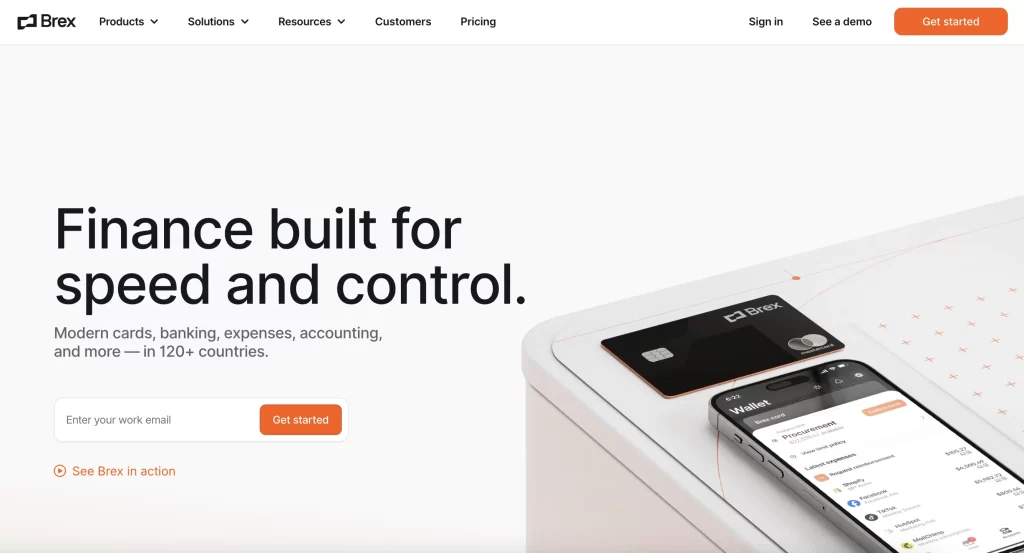
Brex is a spend management platform that includes corporate cards, expense management, bill pay, business banking accounts, and financial automation tools. It helps companies control employee spending, automate approvals and reimbursements, pay vendors, and track all business expenses in real time.
Core Features
- Corporate Cards & Spend Limits: Set budgets and allocate spend limits with auto-enforced controls that empower employees to spend wisely, with the ability to track and adjust in real time.
- Expense Automation: The Brex mobile app uses OCR technology to capture receipt images and automatically extract relevant data (merchant name, amount, date), then categorizes expenses automatically based on merchant information and past patterns.
- Policy Enforcement: When someone attempts to make a purchase, the system automatically checks it against your policies in real time, preventing out-of-policy spending before it occurs.
- Bill Pay: Brex bill pay automates the entire accounts payable process, from vendor onboarding to invoice entry and reconciliation.
- AI-Powered Features: AI-powered expense flagging uses LLMs to detect out-of-policy spend on itemized receipts.
- ERP Integrations: Brex integrates with top ERPs like QuickBooks and NetSuite, helping you close your books every day and enabling in-month reporting.
Who it’s for
Brex is best suited for venture-backed startups, global teams, and companies requiring flexibility in payments, integrations, and employee travel. Companies like DoorDash and Robinhood have used it.
Notable context
In 2026, Brex was acquired by Capital One for $5 billion. The reaction in the startup community has been mixed, with some founders concerned about how independent and startup-focused the platform will remain under a large bank.
Its main competitor is Ramp, which many consider to have stronger automation features. Brex differentiates itself with more flexibility in payments, reward customization, and a broader ecosystem for startup needs.
Ramp
Get a $1,000 sign-up bonus with NachoNacho.
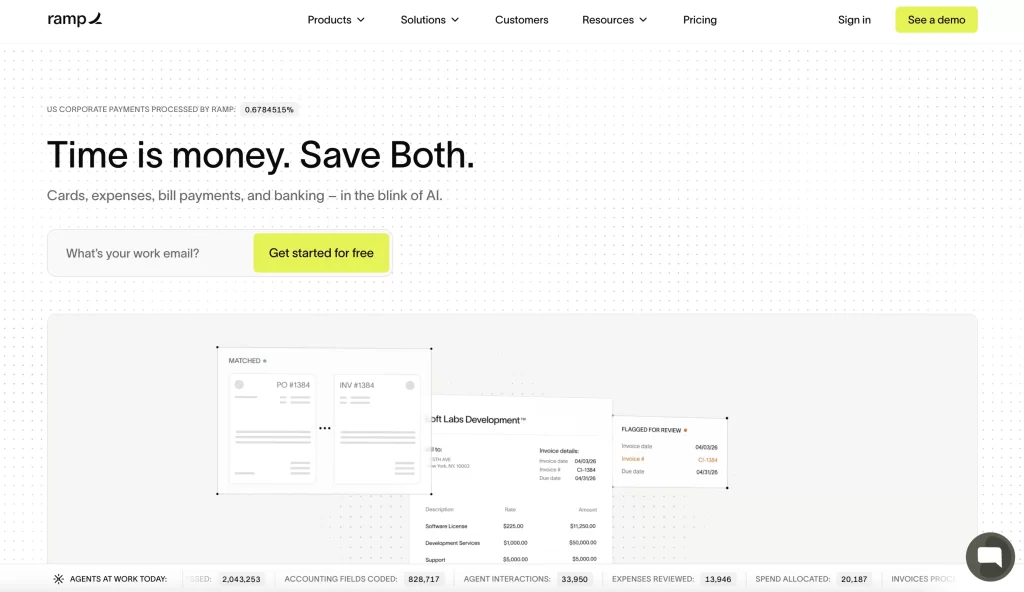
Founded in 2019, Ramp is a platform focused on providing a comprehensive solution that incorporates corporate cards, expense management, bill payments, vendor management, and accounting automation, helping finance teams enhance their efficiency and productivity.
Core Features
- Corporate Cards: Teams can issue unlimited physical and virtual cards with built-in controls, set custom policies, and automate receipt collection to eliminate manual follow-ups.
- AI-Powered Expense Automation: The platform employs machine learning to automatically categorize expenses, match receipts to transactions, and flag inconsistencies, which accelerates approvals and minimizes errors.
- Bill Pay & AP Automation: Ramp Bill Pay uses AI agents that can auto-code invoices, detect anomalies, route approvals, and execute payments with minimal manual intervention, using OCR technology to capture invoice details automatically.
- Cost Savings Insights: The platform analyzes spending habits to recommend actionable savings opportunities, helping businesses optimize their financial resources, including catching unused SaaS licenses or duplicate subscriptions.
- Policy Enforcement: Admins can set custom restrictions by merchant, category, or dollar amount to prevent out-of-policy spending before it happens. Employees can submit expenses via SMS, mobile app, or through integrations like Gmail and Lyft.
- Accounting & ERP Integration: Ramp’s AI can code, review, and sync all transactions to your ERP continuously throughout the month, with real-time syncs supporting 30+ ERPs, including NetSuite, QuickBooks, Xero, Sage Intacct, and Workday.
Pricing
Ramp’s base plan is free to use with unlimited cards, expense policy enforcement, and invoice extraction. Its second tier, Ramp Plus, is $15/user/month.
Where it stands today
Ramp has been growing rapidly. The company passed $1 billion in annualized revenue during 2025 and is currently in talks to raise $750 million at a valuation of over $40 billion, a sharp rise from its $16 billion valuation in mid-2025.
Ramp vs. Brex
Ramp tends to win on automation depth, ease of use, and its free base tier, while Brex has historically been stronger for startups needing more flexible banking and travel features. Many teams that have used both now favor Ramp for its more modern UX and stronger AI-driven savings tools.
The rewards structures also differ meaningfully: Ramp offers up to 1.5% flat cashback, while Brex uses a points-based program with category multipliers, up to 7x on rideshare and 4x on restaurants and travel booked through Brex Travel.
For businesses with heavy spend in those categories, Brex points can outpace Ramp’s cashback, but for general business expenses, Ramp’s flat rate is more predictable.
There’s also a strategic wildcard to consider: Capital One announced the acquisition of Brex in January 2026, valued at approximately $5.15 billion, with customers likely to see product direction, pricing, and policies evolve over time as the platform aligns with the priorities of a large financial institution.
SAP Concur
Get 20% off all SAP Concur plans with NachoNacho.
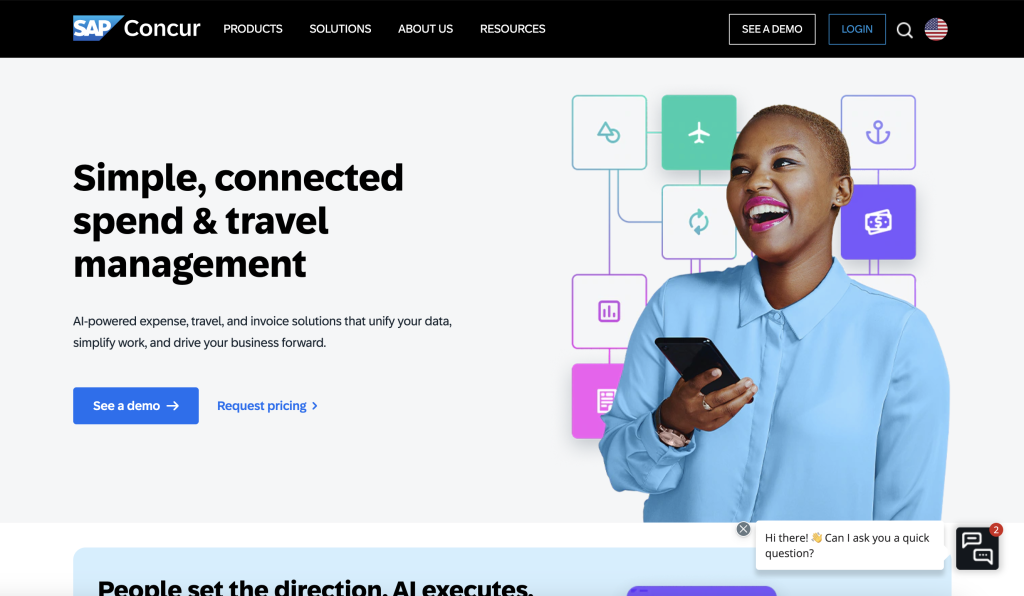
SAP Concur is a cloud-based platform that helps companies manage expense, travel, and invoice processes in one place, automating how employees submit expenses, book travel, and handle invoices, while giving companies better visibility and control over their spending.
Core Features
- Concur Expense: Captures and optically recognizes receipts, and allows employees to create, submit, approve, and process expense reports digitally, with AI-powered categorization and policy enforcement.
- Concur Travel: Enables corporate travel booking with preferred vendors, enforces pre-trip approvals, and applies policy controls, helping companies negotiate better rates and improve forecasting.
- Invoice & AP Management: The platform takes companies beyond automation to a fully connected spend management solution encompassing travel, expense, vendor invoices, compliance, and risk.
- AI with Joule: SAP’s generative AI assistant Joule is built directly into Concur Travel & Expense to automate tasks, answer questions, and streamline spend management, including a new integration with Microsoft 365 Copilot that embeds travel and expense tasks directly into Microsoft apps.
- ERP Integration: SAP Concur integrates natively with SAP ERP systems like S/4HANA; once expenses are approved, they are automatically posted to the ERP, updating cost centers and budgets in real time.
- Compliance & Audit Trail: Every submission, approval, exception, and edit is logged, which matters in regulated industries, public companies, and multinational teams where finance operations need traceability.
Who it’s for
SAP Concur’s strengths are compliance, scalability, auditability, and integration with enterprise finance stacks. Its trade-offs are implementation complexity, user friction, and higher overhead for smaller or fast-moving startups. It’s the go-to choice for large multinationals, regulated industries, and organizations already running SAP’s broader ERP ecosystem.
How it compares to Ramp & Brex
SAP Concur operates in a different tier than Ramp or Brex. While Ramp and Brex are built for speed and simplicity, targeting startups and mid-market companies, Concur is designed for enterprise complexity: multi-entity structures, global compliance, deep ERP integration, and intricate approval hierarchies. The tradeoff is that Concur can feel heavyweight and slow compared to modern alternatives, with many users noting a steeper learning curve and more steps to complete basic tasks.
NachoNacho has partnered with CardRatings for our coverage of credit card products. NachoNacho and CardRatings may receive compensation to promote products. NachoNacho may earn commissions on other links on this article.

Written by Andres Muñoz
If you would like to receive the latest deals added to NachoNacho, make sure you sign up for our newsletter below. We’re adding amazing software discounts you can’t miss!
Sign up for our newsletter