Best Equity Management Software of 2026

Managing your company’s equity becomes more complicated with every new investor, employee grant, and funding round. What starts as a simple spreadsheet can quickly turn into hours of updating ownership records, checking vesting schedules, and finding the right documents.
Equity management software helps you keep these details organized. You can track who owns what, manage employee equity, and prepare for fundraising with a clearer picture of your company’s ownership.
In this guide, you’ll find some of the best equity management software of 2026, for companies looking for cap table management and valuation services together. We’ll also cover alternatives for different business needs and available offers through the NachoNacho marketplace.
Quick Answer: Which Equity Management Software Is Best?
The best equity management software depends on your company’s stage, equity structure, and the capabilities you need beyond basic cap table management.
- Eqvista: Best all-around option for startups and private companies that want equity management and in-house valuation services from one provider, with support from early stage through pre-IPO.
- Carta: Best for companies looking for a broad equity management suite.
- Cake Equity: Best for companies prioritizing the employee equity experience.
- Qapita: Best for companies that need broader employee stock plan support.
- Fidelity Private Shares: Best for companies that prioritize connecting ownership records with supporting documents.
- Ledgy: Best for growing teams focused on employee equity administration and automation.
What is equity management?
Equity management is the process of organizing and maintaining your company’s ownership records and equity compensation arrangements. It covers the interests held by founders and investors, along with equity awards granted to employees and advisors.
When you first start a business, keeping track of ownership might seem straightforward. You have a small number of founders, an agreed ownership split, and relatively few transactions. As you raise capital and offer equity to your team, there are more details to manage.
A funding round can change existing shareholders’ ownership percentages. An employee stock option grant introduces terms and a vesting schedule that need to be tracked. Investors may also request updated ownership reports and the documents behind previous transactions.
Equity management brings these activities together throughout the company’s growth. It can include maintaining the capitalization table, administering grants, tracking vesting, preparing reports, and coordinating valuations. Eqvista’s equity management overview explains how these functions fit together.
Why is equity management important?
Your ownership records affect conversations with investors, employees, and your internal team. Keeping them organized makes it easier to explain where the company stands and evaluate what happens next.
Prepare for fundraising
Before negotiating a new investment, you need to understand your current ownership structure and how the proposed terms could change it.
Fundraising modeling tools let you explore different investment amounts, valuations, and option pool sizes. This helps you understand potential dilution—the reduction in an existing holder’s ownership percentage—and compare financing scenarios before entering discussions with investors.
Keep employee equity organized
Offering equity creates ongoing administrative work. Your team needs to record grants, monitor vesting schedules, manage exercises, and keep the associated documents accessible.
Employees also need a clear view of their awards. A dedicated dashboard lets them review grant details and track vesting progress, making it easier to understand their equity and find answers without contacting your HR or finance team every time.
Make ownership records easier to review
When an investor or advisor asks about a transaction, the numbers are only part of the answer. Your team may also need the signed agreement, approval, and related records.
Keeping those documents connected to your ownership data can make reviews more manageable. Fidelity Private Shares links cap table records to supporting documents, for example, so teams can trace the paperwork behind equity transactions.
What is equity management software?
Equity management software provides a shared system for handling ownership and equity administration. Depending on the product and plan, it can help you issue securities, update ownership records, manage grants, track vesting, model financing scenarios, and share information with stakeholders.
A cap table records your company’s ownership structure. Broader equity management software adds workflows around that information, such as grant administration, employee access, reporting, and valuation services.
For example, Eqvista offers cap table and employee equity tools alongside valuation services. Other platforms place more emphasis on document management, employee communications, or international stock plans.
The right choice depends on the work your team needs to handle today and the additional complexity you expect as your company grows.
Best equity management software at a glance
Here’s a quick comparison of the platforms covered in this guide, including pricing starting points and published NachoNacho offers.
| Equity management software | Pricing overview | NachoNacho offer |
| Eqvista | Free plan available; Premium listed at $2 per stakeholder/month, with custom pricing above 50 stakeholders | 20% off all plans for the first year |
| Carta | Free Launch plan for eligible startups; paid plans require a quote | 20% first-year discount |
| Cake Equity | Free for up to 5 stakeholders; Build listed at $1,000/year for 25 stakeholders | 10% off the first year plus premium onboarding |
| Qapita | Free Spark plan for eligible startups; Surge listed at $1,600/year for up to 40 stakeholders | 20% ongoing cashback on all plans for eligible new accounts |
| Fidelity Private Shares | Free Launch plan for eligible startups; contact the provider for paid pricing | Free Launch program or 20% discount |
| Ledgy | Free Launch plan; Scale starts at €5,000/year | Listed on NachoNacho; no specific discount published |
Pricing sources are linked in each product section below. Subscription prices are shown before marketplace offers. Plan limits, eligibility requirements, and offer terms apply and may change.
What to look for in equity management software
Before choosing a platform, consider how it will support your company’s actual workflows.
Cap table management: Check that the platform supports the securities your company uses. Ask the provider to demonstrate transaction history, ownership reports, and how changes are reflected in the cap table.
Equity grants and vesting: Review how the software handles new grants, different vesting schedules, exercises, and employee departures.
Fundraising modeling: If you plan to raise capital, look for tools that let you explore investment terms and ownership changes using your company’s data.
Valuations and reporting: Confirm which services are included in the subscription and which cost extra. Find out whether valuations are performed in-house or outsourced, what types of valuations are available beyond 409A, and what support is available for questions from your finance team or auditors.
Employee access: Look at the platform from an employee’s perspective. Grant information and vesting details should be easy to find and understand.
Pricing and onboarding: Compare costs at your current stakeholder count and the size you expect to reach. Ask what migration includes, who checks imported records, and whether onboarding has a separate fee.
Top equity management platforms in 2026
Eqvista
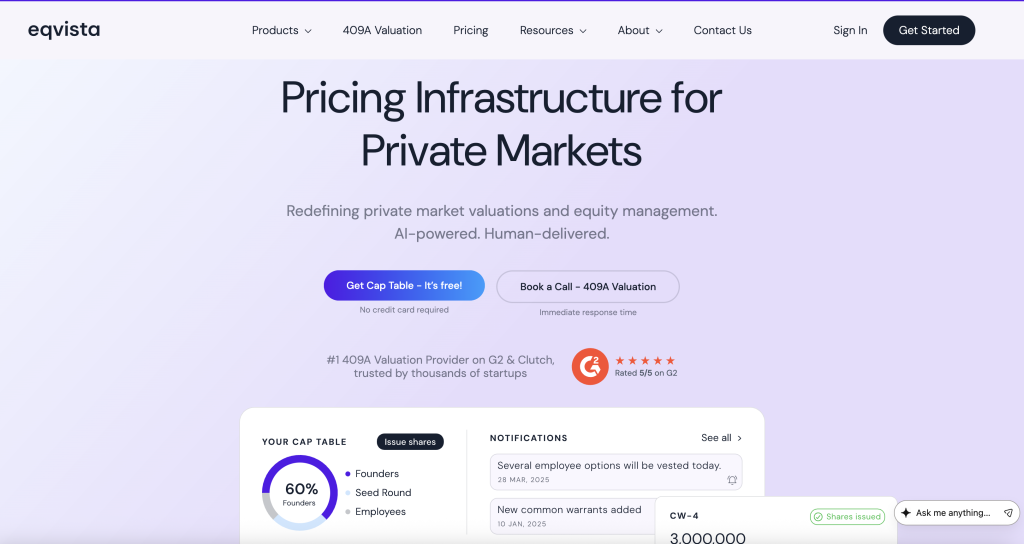
Eqvista combines cap table management and employee equity administration with in-house 409A valuations and broader business valuation services. It’s our main recommendation for startups and growing companies that want to manage equity and valuations through the same provider, from early stage through pre-IPO.
You can use the platform to manage your cap table, monitor vesting schedules, give stakeholders access to their information, and keep documents in a data room. Premium features add electronic signatures, financial modeling, board resolutions, and voting.
A key differentiator is the combination of equity management software and an in-house valuation team within the same provider. Eqvista also includes funding round and exit modeling in its Premium offering. Its valuation services include 409A valuations alongside broader business and specialized valuations. Companies can also access Eqvista Real-Time Company Valuation®, which provides continuously updated private-company valuation insights rather than relying only on periodic valuation reports. You can compare the included capabilities on Eqvista’s features and pricing page.
The free entry point, transparent Premium pricing, in-house valuation expertise, and ability to support companies from early stage through pre-IPO make Eqvista one of the most complete options in this comparison.
Eqvista pricing
Eqvista discount: Save 20% on all plans for the first year through NachoNacho.
Published Eqvista pricing includes:
- Freemium Cap Table: $0, with stakeholder limits.
- Premium Cap Table: $2 per stakeholder per month, with custom pricing above 50 stakeholders.
- 409A Valuation plans: Stage-based pricing starting at $990 per year, with Premium Cap Table included.
Valuation pricing varies based on factors including company stage, revenue, funding, and ownership structure.
Carta
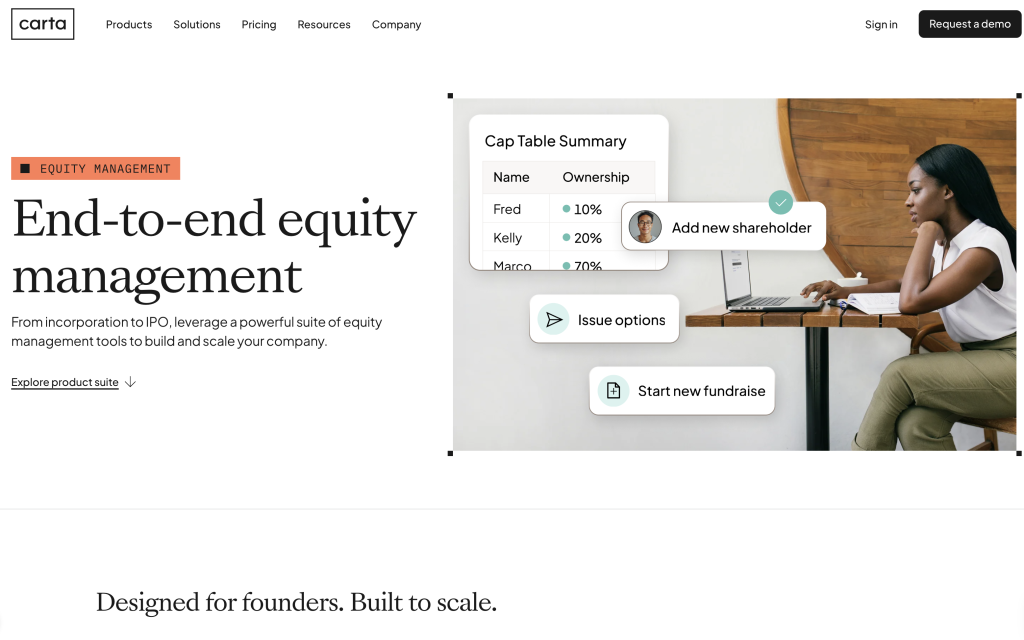
Carta offers an equity management suite covering cap tables, valuations, compensation, and liquidity programs. It’s worth considering if you want access to a broad set of services as your company develops.
Its cap table tools support issuing and tracking securities. The wider suite includes compensation benchmarking, employee equity advisory services, and capabilities for running tender offers.
Companies with more involved reporting needs can also explore Carta’s advanced packages. Its plans separate core administration from valuation, financial reporting, and exit planning features, so the package you choose matters.
During a demo, focus on the tools your team will actually use and ask which services require additional purchases.
Carta pricing
Carta discount: Get 20% off your first year through the NachoNacho marketplace.
According to Carta’s pricing page:
- Launch: Free for eligible early-stage companies.
- Build: Contact sales for pricing.
- Grow: Contact sales for pricing.
- Scale: Contact sales for pricing.
Paid pricing depends on your package, stakeholder count, minimum annual fee, and selected add-ons.
Cake Equity
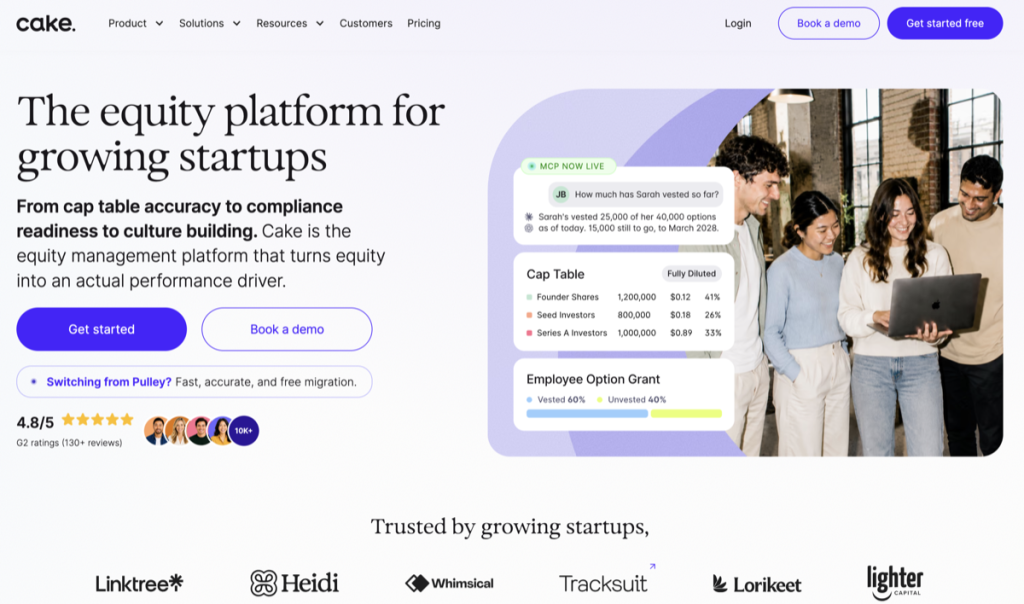
Cake Equity is a useful option for companies that want to manage ownership while helping employees understand their equity.
The platform includes cap table management, fundraising modeling, and tools for handling SAFEs and convertible notes. Its employee app, My Cake, gives team members a dedicated place to access their equity information.
If employee ownership is an important part of your compensation strategy, include the employee experience in your evaluation. Review how awards are presented and whether the information is clear enough for someone who doesn’t work in finance.
Cake’s plans provide a path from basic cap table administration to more advanced equity and reporting requirements.
Cake Equity pricing
Cake Equity discount: Save 10% on your first year and receive premium onboarding through NachoNacho.
Published Cake Equity pricing includes:
- Free: $0 for up to 5 stakeholders.
- Build: $1,000 annually, including 25 stakeholders.
- Team: $2,750 annually, including 40 stakeholders.
- Pro: Custom pricing.
Additional stakeholder charges apply. Check the selected plan for valuation and reporting inclusions.
Qapita
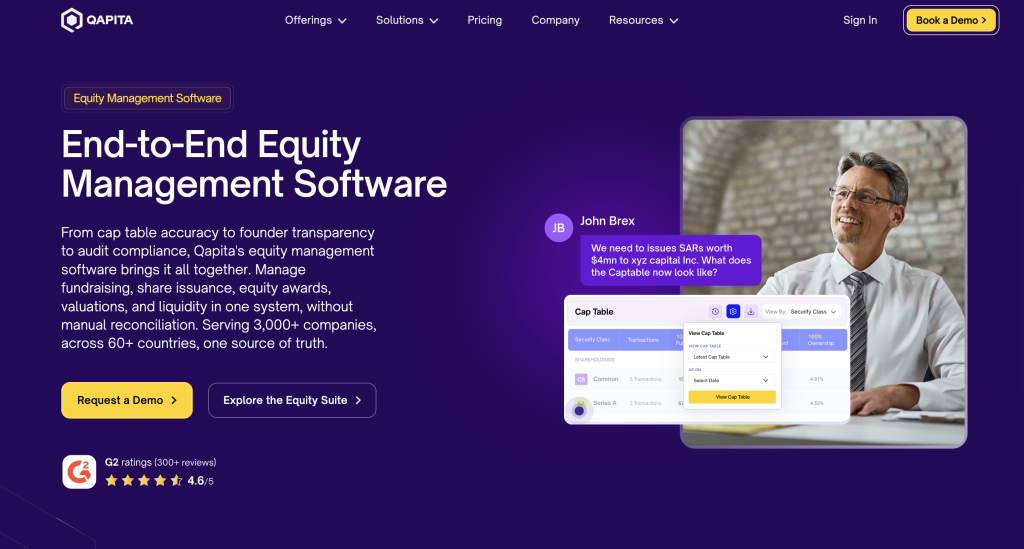
Qapita is worth exploring if your company needs cap table management alongside broader employee stock plan support.
Its offering covers fundraising, share issuance, equity awards, valuations, and liquidity workflows. Companies can also use scenario modeling and employee equity communications as their ownership programs grow.
Qapita offers services beyond software, including equity plan design and administration support. This may appeal to teams that need additional help running their equity programs.
For businesses with employees across different countries, ask the provider to demonstrate how it supports your locations, award types, and reporting requirements.
Qapita pricing
Qapita offer: Eligible new accounts can get 20% ongoing cashback on all plans through NachoNacho. The offer is provided as cashback rather than an upfront reduction in the vendor’s invoice.
Qapita’s published pricing includes:
- Spark: Free for companies with up to 25 stakeholders and less than $1 million raised.
- Surge: $1,600 per year for up to 40 stakeholders, with additional stakeholder charges.
- Growth and Enterprise: Confirm pricing for your region, package, and service requirements.
Fidelity Private Shares
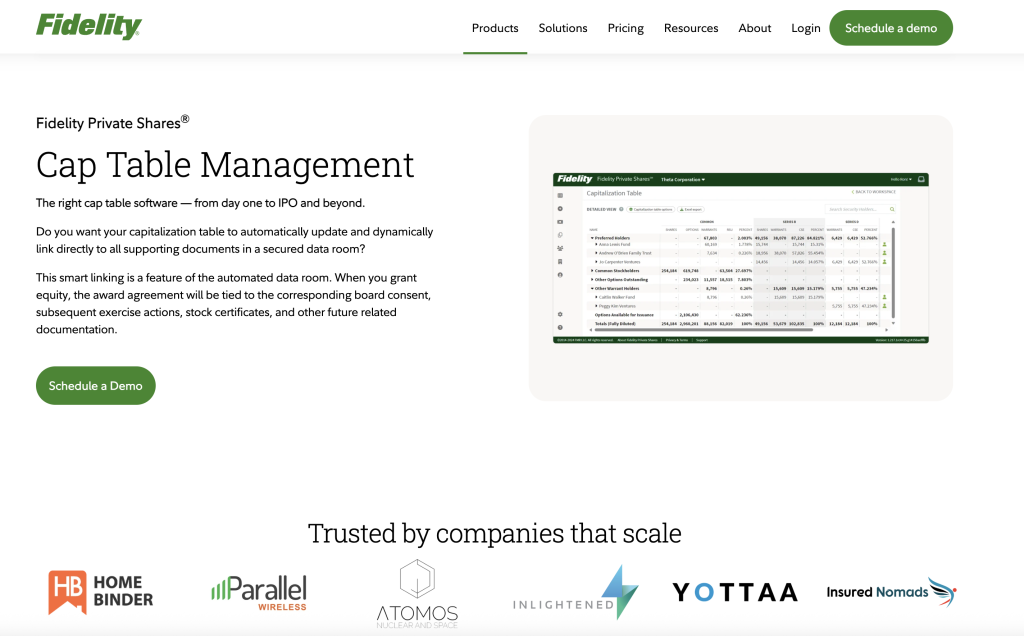
Fidelity Private Shares is a strong option to explore when connecting ownership records with supporting documents is a priority.
Its cap table links to an automated data room. Grant agreements can connect to related board consents, exercise records, and stock certificates, helping your team review the documentation behind transactions.
The platform also provides employee access and permission controls for other stakeholders. That can be useful when founders, lawyers, investors, and finance teams need different views of the same information.
If fundraising preparation regularly involves searching for agreements and checking missing records, these document management capabilities deserve a closer look.
Fidelity Private Shares pricing
Fidelity Private Shares offer: Explore the free Launch program or 20% discount listed on NachoNacho.
According to its pricing page:
- Launch: Free for companies with up to 25 stakeholders and less than $1 million raised.
- Startup: Contact the provider for pricing.
- Growth: Contact the provider for pricing.
- Scale: Custom pricing.
The Launch plan includes cap table management, a data room, board consents, and scenario modeling. More advanced services depend on the selected package.
Ledgy
Ledgy is worth considering for companies that want to automate employee equity administration as their teams grow.
Its paid plans include HR system integrations, document workflows, grant automation, and employee dashboards. These capabilities can help connect equity administration with changes across your workforce.
Ledgy also offers financial reporting and valuation services, along with tools for companies preparing to go public. During your evaluation, confirm which capabilities are included in the subscription and which require an add-on.
Ledgy pricing
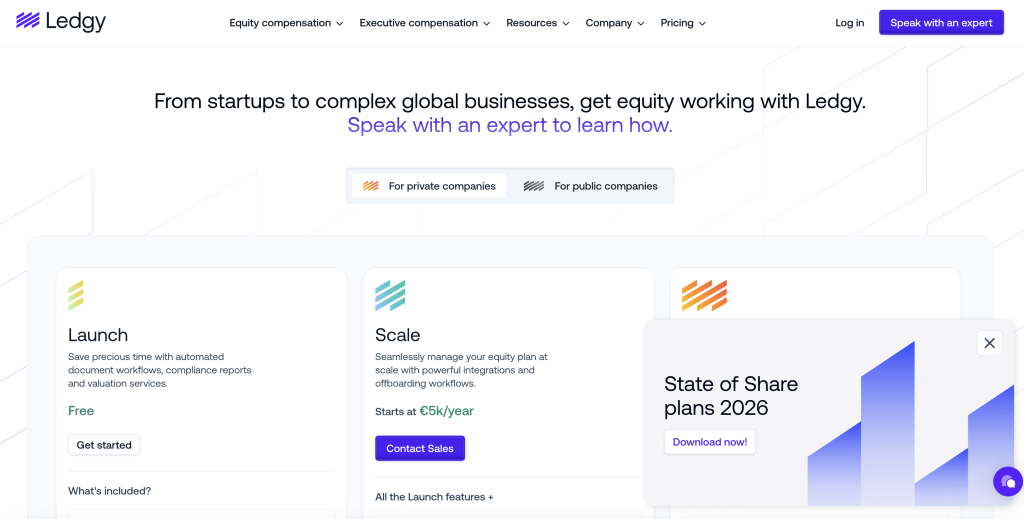
Published Ledgy pricing includes:
- Launch: Free.
- Scale: Starts at €5,000 per year.
- Enterprise: Starts at €18,000 per year.
- Public company plans: Custom pricing.
Financial reporting and valuation add-ons may cost extra. Ledgy is listed on NachoNacho, although the listing does not publish a specific discount.
How much does equity management software cost?
The platforms in this guide offer everything from free entry-level plans to annual subscriptions and custom packages. The amount you pay depends on stakeholder count, required features, and the services included.
When comparing quotes, consider the total cost of the setup you need. A basic subscription may not include valuations, stock compensation reporting, migration, or additional administrative support.
Ask each provider to price the same requirements. For example, request a quote that covers your expected stakeholder count, grant administration, required reports, and valuation needs. This makes the comparison more useful than looking at the starting subscription price alone.
Also check the offer’s duration and how it is delivered. A first-year discount reduces the initial cost, while cashback follows a different redemption process. The linked NachoNacho listings explain the available terms.
Which equity management software should you choose?
Whether you’re building your first cap table or managing equity across a growing company, the right software depends on your ownership structure, valuation needs, budget, and growth plans.
For startups and growing private companies that want cap table management and in-house valuation services from the same provider, Eqvista is our top overall recommendation. Companies with different priorities, such as international equity administration, employee communications, or document management, may find another platform in this comparison better suited to their needs.
Once you’re ready, explore the equity management software deals on NachoNacho to see how much you could save on your subscription.