AI Credits for Startups in 2026: Programs, Eligibility, and Ways to Save

Your first AI bill usually arrives sooner than you expect. A prototype that ran on a few dollars of API calls turns into a product feature, then an agent, then a line item your CFO asks about.
AI credits for startups can help cover the cost of model usage, cloud hosting, and development while you build. But the headline amount rarely tells the whole story. Eligibility, expiration dates, covered services, and spending requirements determine how much value your startup can actually use.
This guide breaks down the main programs, explains what to check before applying, and shows how to keep software costs manageable after the credits run out.
Program information reviewed October 28, 2026. Offers and eligibility requirements can change; confirm the current terms before applying.
What are AI credits?
AI credits are promotional allowances that cover eligible usage of a provider’s services. Depending on the program, they may be expressed as a dollar balance or product-specific usage units.
They generally fall into three categories:
- Model API credits: Cover eligible requests made directly to a model provider.
- Cloud credits: Cover eligible infrastructure and services, potentially including compute, storage, databases, and hosted AI models.
- Tool credits: Cover usage within a particular application, such as voice generation, search, or data enrichment.
Credits, discounts, and cashback work differently. Credits cover a limited amount of usage. Discounts reduce an eligible price. Cashback returns part of an eligible payment under the offer’s terms.
Before applying, check the expiration date, eligible services, prior-credit restrictions, and what happens when the balance reaches zero.
AI credits for startups: quick comparison
The largest advertised award is not necessarily the best fit. Start with the platform your product needs, then compare the benefits your business qualifies for.
| Program | Published credit opportunity | Main condition |
|---|---|---|
| AWS Activate | Founders starts at $1,000; Portfolio offers up to $200,000 | Portfolio requires an Activate Provider Organization ID; additional eligibility rules apply |
| Google for Startups Cloud Program | Up to $350,000 over two years for eligible AI startups | VC funding, company age, Gemini usage, and prior-credit requirements |
| Microsoft for Startups | Standard-program milestones can reach $150,000 | Higher limits depend on verification, service adoption, and sustained Azure usage |
| Cloudflare for Startups | $10,000, $100,000, or $350,000 by tier | Funding and partner requirements vary; individual services have limits |
| AWS credits through NachoNacho | Up to $5,000 for eligible Basic Plus members | AWS approval and prior-credit rules apply |
These are conditional program benefits, not guaranteed awards for every applicant.
Cloud credit programs for AI startups
AWS Activate
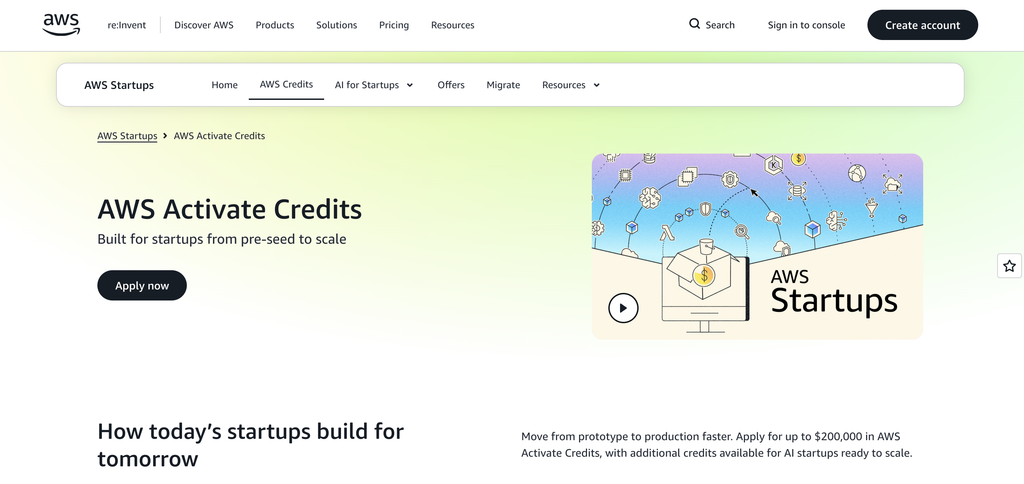
AWS Activate offers two main routes:
- Founders: Starts with $1,000 for eligible startups. Selected recipients may qualify for up to $5,000 over time.
- Portfolio: Offers up to $200,000 through an Activate Provider, which may be a VC firm, accelerator, or startup organization.
Applicants generally need to be pre-Series B, less than 10 years old, and meet AWS account and prior-credit requirements. Portfolio applicants need their provider’s Organization ID.
Eligible credits can cover Amazon Bedrock usage, making the program useful for teams building with hosted AI models. AWS also describes additional opportunities for qualifying AI startups beyond its standard tiers. See the AWS Activate program for current terms.
Google for Startups Cloud Program
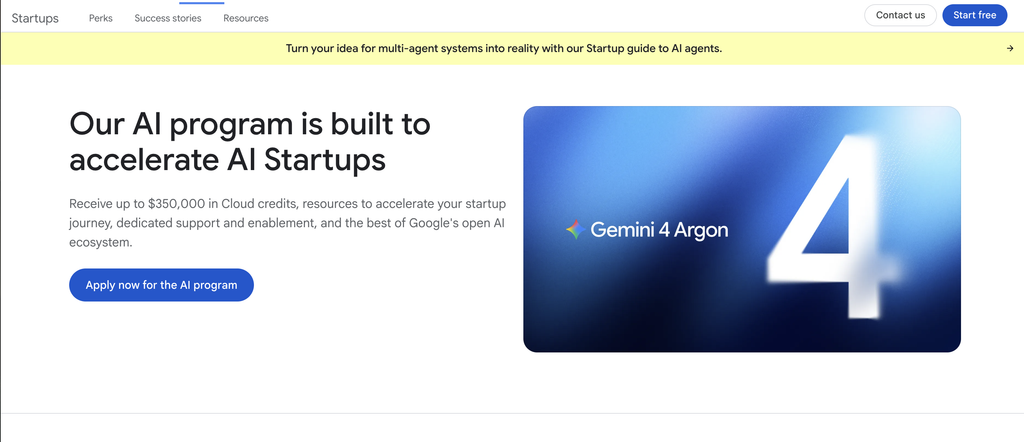
Google’s AI startup offer provides up to $350,000 over two years, with different coverage in each year:
- Year 1: Covers 100% of eligible usage, up to $250,000.
- Year 2: Covers 20% of eligible spending, up to an additional $100,000.
The second-year benefit therefore requires substantial spending by the startup; it is not another fully funded $100,000 balance.
The AI tier targets eligible VC-funded companies founded within the past five years that use or plan to use Gemini as a foundation of their product. Funding dates and previous Google Cloud credits also affect eligibility.
Program credits cover Google models such as Gemini and Gemma, while third-party models are excluded. Review the Google Cloud AI startup requirements before budgeting around the offer.
Microsoft for Startups
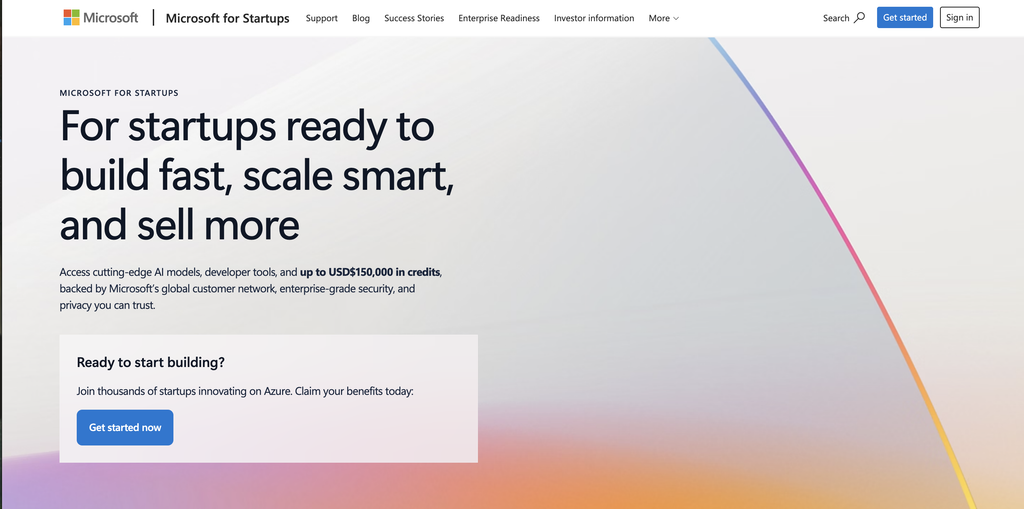
Microsoft’s standard program uses credit milestones rather than one fixed award. Its published progression starts at $200, reaches $5,000 after business verification, and can increase to $25,000, $50,000, and $150,000.
Higher milestones require adoption of Azure services and sustained usage. The $150,000 milestone, for example, includes requirements for at least 10 workloads and approximately $3,000 in monthly Azure usage over 60 days.
These are conditional credit limits, so founders should not assume they receive the maximum when signing up. See Microsoft’s standard-program milestones.
Eligible startups backed by Microsoft Investor Network partners may unlock up to $200,000 under the separate Investor Network benefits.
Cloudflare for Startups
Cloudflare advertises three credit tiers for a one-year program:
- $10,000: For qualifying bootstrapped or self-funded startups with less than $1 million raised.
- $100,000: For qualifying startups with less than $5 million raised and funding from an affiliated partner.
- $350,000: For qualifying startups with at least $5 million raised and funding from an affiliated partner.
The total award is not an unrestricted AI budget. Workers AI has a sublimit of up to $50,000, and R2 has a sublimit of up to $10,000.
Check the Cloudflare startup program for company eligibility and service-specific limits.
Direct AI model credits
Anthropic and Claude
At the time of review, the public Claude Startups cohort is full and is not accepting new applications.
A separate route remains relevant for startups backed by participating VC firms: eligible companies may receive up to $100,000 in additional Claude API credits through their investor.
These credits apply to the first-party Claude API. They do not transfer to Claude usage through AWS, Google Cloud, or Azure.
Claude Startups also advertises partner discounts and credits worth up to $45,000 for members. That figure represents partner benefits, not a $45,000 Claude API grant. Check the Claude Startups page for availability and current terms.
OpenAI
OpenAI lists a startup program through its developer community.
Before including OpenAI credits in your budget, confirm the actual offer available to your company: the award amount, eligibility, expiration date, covered services, and redemption process.
Do not assume an amount advertised by an accelerator or another third party applies to every startup. Budget around the offer you have been approved to receive.
Other AI infrastructure programs worth checking
Specialized programs can be useful when their benefits match a specific part of your product.
| Program | What to know |
|---|---|
| Modal for Startups | Offers GPU credits for eligible startups. The public page does not provide one universal award amount; funding and partner requirements vary by tier. |
| ElevenLabs Startup Grants | Advertises 12 months of access with 33 million characters for qualifying startups with fewer than 25 employees. Product and business eligibility requirements apply. |
| NVIDIA Inception | A free program with no equity requirement or funding minimum. Benefits include technical resources, preferred pricing, and cloud credit opportunities from NVIDIA and partners; there is no single universal credit amount. |
Apply when you have a clear use for the service. An offer adds little value if you need to rebuild part of your product simply to use it.
Find AI credits and software deals through NachoNacho
Cloud credits help fund infrastructure, but startups also pay for the applications around their product: sales tools, analytics, collaboration software, and AI subscriptions.
The NachoNacho Marketplace provides another place to compare credits, discounts, and cashback offers. Each deal has its own eligibility and redemption terms.
AWS credits for eligible Basic Plus members
NachoNacho’s AWS credit offer provides up to $5,000 in credits for eligible Basic Plus members, subject to AWS’s requirements and approval.
The offer can apply to eligible new and existing AWS users. If you have already redeemed AWS credits below the offer’s threshold, you may qualify for the difference rather than another full award.
For example, an eligible startup that previously received $1,000 could receive an additional $4,000 under a difference-based award. Confirm your account’s eligibility before including that amount in your budget.
Credits for other tools in your stack
Other marketplace offers include:
- Vectara: Up to $5,000 in combined platform credits and discounts, with a startup application required. The headline amount should not be treated as a guaranteed $5,000 credit balance.
- Clay: 3,000 Clay credits for qualifying new accounts that activate a paid workspace through the offer. These are product usage credits, not $3,000 in cash. The listed redemption terms provide the credits 30 days after the first payment.
For recurring savings, browse NachoNacho’s AI and SaaS offers. Check whether each benefit is a discount or cashback, how long it lasts, and whether it applies to your plan.
How to prepare a stronger application
A clear application makes it easier for a provider to assess your startup. Before applying:
- Choose the platform you expect to use. Estimate your eligible spending and consider the work required to adopt or migrate to it.
- Prepare your company information. Keep your website, business email, incorporation details, product description, and funding information consistent.
- Check partner access. If you have investors or belong to an accelerator, ask which startup programs they support and whether a referral is required.
- Review previous awards. Existing credits may affect your eligibility or reduce the amount of a new award.
- Read the coverage rules. Confirm that the services and models you need are included.
- Record the terms after approval. Save the award amount, activation deadline, expiration date, exclusions, and post-credit billing behavior.
Avoid applying solely to collect headline amounts. A smaller award on your existing platform may save more than a larger one that introduces migration costs and extra maintenance.
What happens when AI credits run out?
The answer depends on the provider and your account settings. Eligible usage may move to paid billing, require a plan change, or become restricted.
For example, ElevenLabs says its startup grant account reverts to the Free plan when the grant expires or is depleted unless you choose otherwise. Do not assume every program continues automatically on a paid plan. See its grant terms and FAQ.
Before your credits end, estimate what the same workload would cost without them. Include hosting, storage, model calls, and the software subscriptions your team uses to operate the business.
This is also a useful time to review unused seats, overlapping tools, and subscriptions that no longer support your workflow. Marketplace savings can reduce eligible purchases, but canceling something you do not need removes the cost entirely.
How to make AI credits last longer
Treat your credit balance as a limited operating budget.
- Match the model to the task. Test whether a smaller model can meet your quality requirements before using a more expensive one for every request.
- Limit automated workloads. Set boundaries for agent iterations, retries, output length, and concurrent jobs.
- Evaluate caching and batch processing. Where supported, compare their pricing and response-time trade-offs against your workload.
- Configure spending alerts. Remember that an alert is a notification, not necessarily a hard spending cap. Check which controls your provider supports.
- Track expiration dates. Review your remaining balance alongside expected usage so you can plan around the deadline.
- Forecast costs without credits. Maintain a full-price estimate as your product grows, rather than waiting until the promotional balance is nearly gone.
Avoid buying unnecessary services just to reach a larger credit tier. Compare any additional spending with the benefit your startup can realistically use.
Frequently asked questions
Can bootstrapped startups get AI credits?
Yes. Programs such as AWS Activate Founders and Cloudflare’s entry tier offer routes for eligible self-funded startups. Microsoft’s standard program also provides a path based on verification and usage. A VC investment is not a universal requirement.
Can you combine credits from different providers?
Potentially, provided each program’s terms allow it. Track each balance separately: credits from one provider cannot automatically pay another provider’s bill.
Within the same program, a higher award may replace or top up an earlier limit rather than add a completely separate balance.
Are AI credits the same as free software?
No. Credits cover defined usage for a limited period. Excluded services, usage above the allowance, membership requirements, or paid-plan conditions can still create costs.
Which program should a startup apply to first?
Start with the platform your product already uses or is most likely to need. Compare eligibility, covered services, expiration dates, and your expected bill after the credits end.
Build with credits. Plan for ongoing costs.
AI credits can give your startup more room to test, launch, and grow. Their value depends on how closely the offer matches your actual workload and how much of it you can use before it expires.
Choose relevant programs, confirm the terms, and track your costs from the beginning. Then review the rest of your software stack for savings that remain useful as your business grows.
Explore AI tools, startup credits, and SaaS deals on NachoNacho.