
Top Compliance Management Software for AI Companies

Compliance management software for AI-driven SaaS teams is a now sales prerequisite.
The global market for continuous control monitoring—the real-time core of modern compliance platforms—hit USD 1.98 billion in 2024 and is projected to reach USD 6.23 billion by 2033, according to a 2024 analysis from Dataintelo. Gartner’s March 2025 Market Guide for DevOps Continuous Compliance Automation Tools confirms that DevOps-ready compliance automation is now a board-level mandate.
Legacy GRC suites were built for annual audits and waterfall releases. They struggle to ingest streaming evidence and they don’t fit cleanly into CI/CD. Single-framework checklist apps break the moment you expand into a new region, a new customer segment, or a new regulation.
If you’re moving fast, you need software that connects to GitHub, Terraform, and AWS, evaluates controls continuously, and scales with your team. That lens shaped the short list you’re about to see.
Selection criteria
We prioritized platforms that can keep up with modern engineering teams:
- Support at least two internationally recognized security or privacy frameworks
- Automate evidence collection through native cloud and DevOps integrations
- Provide real-time control monitoring, not quarterly snapshots
- Maintain a 4.5-star or higher average rating from verified users
- Provide tiered pricing for startups and clear modular paths for enterprise scaling
According to Vanta’s published SOC 2 and AI compliance documentation, its platform runs more than 1,200 automated tests every hour across cloud, identity, and code tools and connects to hundreds of third-party services, which is the kind of cadence and integration density we treated as a baseline for “continuous monitoring” in this guide.
Find your fit in 30 seconds
Pick the platform that matches how your company runs today, and what it will look like a year from now. Compliance tooling breaks down most often when your headcount, frameworks, or data footprint grows faster than the product you bought.
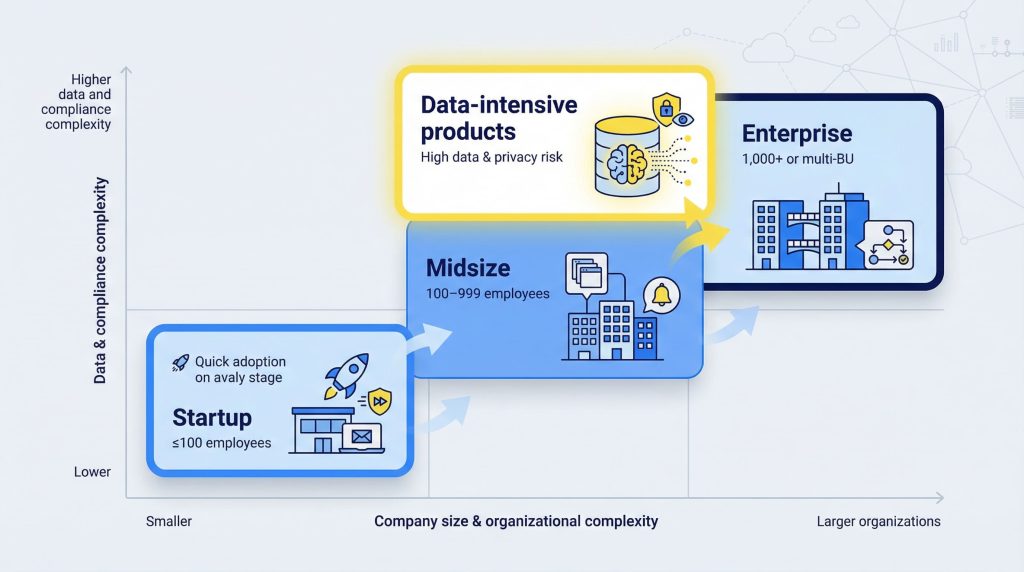
Use these segments to self-sort:
- Startup (≤100 employees, Seed–Series B): Prioritize speed to SOC 2 readiness, minimal setup, and integrations that turn on fast. The goal is to finish the audit without turning engineers into screenshot machines.
- Midsize (100–999 employees): Gartner classifies this as the “midsize enterprise” band. At this stage, multi-framework mapping and frequent drift alerts matter more than one-time audit prep. You need systems that stay accurate between releases.
- Enterprise (1,000+ employees or multiple business units): Workflow builders and modular suites start paying off when ownership gets distributed, approvals slow down, and acquisitions introduce inconsistent controls across teams.
- Data-intensive products: If your model touches millions of personal records, lead with privacy assessments and a clear path into emerging AI-governance workflows. Security compliance gets you into procurement. Privacy and AI risk management keep you there.
Each tool profiled next is labeled with one or more of these segments, so you can jump straight to the best fit.
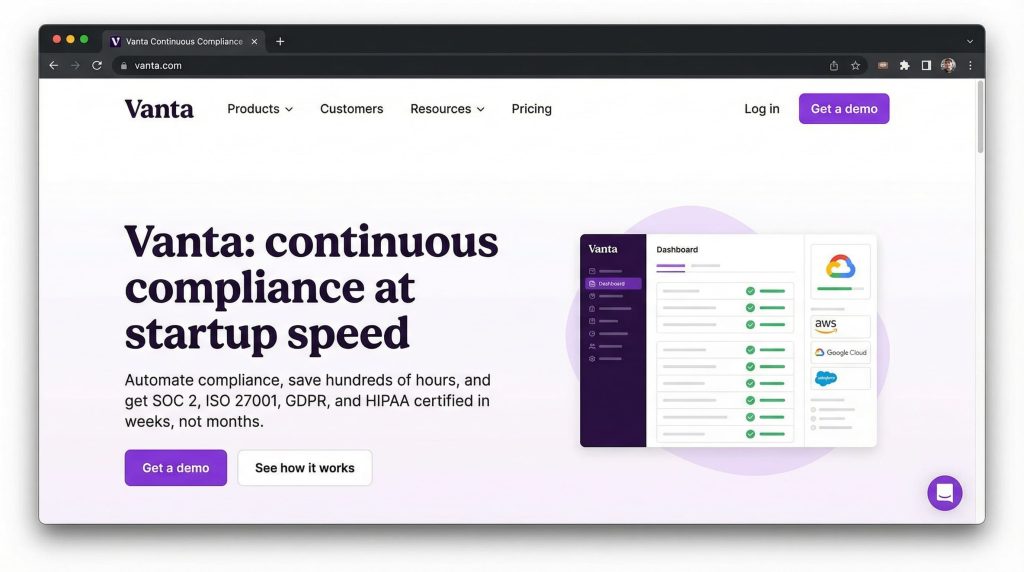
Vanta: continuous compliance at startup speed
Vanta is built for teams that want compliance to run like the rest of their engineering stack. Connect your cloud and DevOps tools, monitor controls continuously, and keep evidence in an auditor-ready workspace—a workflow pattern that Vanta’s 2026 compliance management software guide report says cuts roughly 82 percent of the effort required for each framework audit.
It shows up in time-to-value. Dust, an AI platform with about 70 employees, reached SOC 2 Type II readiness in three weeks using Vanta’s automation stack. Keeper Finance reports it cut its audit timeline in half and eliminated months of manual screenshots by relying on pre-built tasks and automated evidence pulls.
Vanta is a strong fit if you are:
- An AI-native SaaS team, such as a customer-facing AI support platform, that ships frequently and needs controls to stay accurate between releases
- Scaling from a first SOC 2 into multi-framework coverage (ISO 27001, HIPAA, GDPR modules) without rebuilding your program
- Tired of “audit prep season” and want drift alerts to land where work happens (Slack, ticketing, CI/CD)
What Vanta does well for AI-driven SaaS teams
Automation depth that matches CI/CD pace
Vanta’s core value is continuous monitoring tied to real systems. Its control engine evaluates configurations and activity across your stack and alerts when something drifts, for example IAM permissions, GitHub activity, and AWS configuration changes, then pushes remediation into workflows like Slack. Vanta publishes more than 300 native integrations. Based on available data as of 2025, the broader catalog is in the 375+ range, with around 1,200 automated tests running hourly.
AI assistance that focuses on closing gaps
When a control fails, Vanta’s agent can review what broke and suggest specific fixes, including Terraform-level guidance, then sync updates into the auditor-facing workflow. In practice, this reduces the slowest part of most programs—the back-and-forth to identify the real root cause and document the resolution.
Framework coverage that scales with you
Vanta supports 35+ frameworks and is commonly used to move from SOC 2 into ISO 27001, HIPAA, and GDPR modules as customer requirements expand. For AI-centric frameworks such as ISO/IEC 42001 and NIST AI RMF, template availability and mappings evolve quickly, so it is worth validating current coverage during a demo if AI governance is part of your near-term roadmap.
Audit, trust sharing, and third-party risk
If your sales cycle includes repetitive security reviews, trust-sharing features matter as much as control monitoring. Vanta supports auditor collaboration through an in-product audit view/portal, and it also offers Trust Center capabilities, including an AI chatbot, to help prospects self-serve answers with the right access controls.
On third-party risk, Vanta offers a vendor risk management add-on. Based on available data, Vanta Exchange reached general availability in mid-2025. Depth varies by release, so if vendor questionnaires and continuous monitoring are a primary driver, ask to see the exact workflows you need end-to-end.
Pricing and rollout expectations
Vanta packaging is modular. Pricing is quote-based and typically scales as you add frameworks and adjacent modules. Teams often choose it when they want fast onboarding and ongoing, automated control health instead of a tool that is only useful at audit time.
Watch-outs
Vanta is not always the best first choice if you need a fully build-your-own GRC “fabric” for highly bespoke enterprise workflows across a large internal audit organization. Platforms built around custom workflow design can be a better fit in those cases, with a trade-off in out-of-the-box automation density.
Buyer checklist (questions to ask in a demo)
- What percentage of our in-scope controls will have automated, hourly tests, based on our exact stack?
- Show a failed cloud or IaC test and walk through code-level remediation guidance.
- How do auditors collaborate in the audit view, and what does evidence traceability look like back to source systems?
- Demonstrate Trust Center workflows for gating access and handling prospect Q&A at scale.
- If we care about AI governance, what ISO/IEC 42001 or NIST AI RMF content exists today, and how is it maintained as standards change?
Vanta is a strong choice when you want a compliance program that stays current as you ship, and when you want automation to carry most of the burden of evidence instead of your engineers.
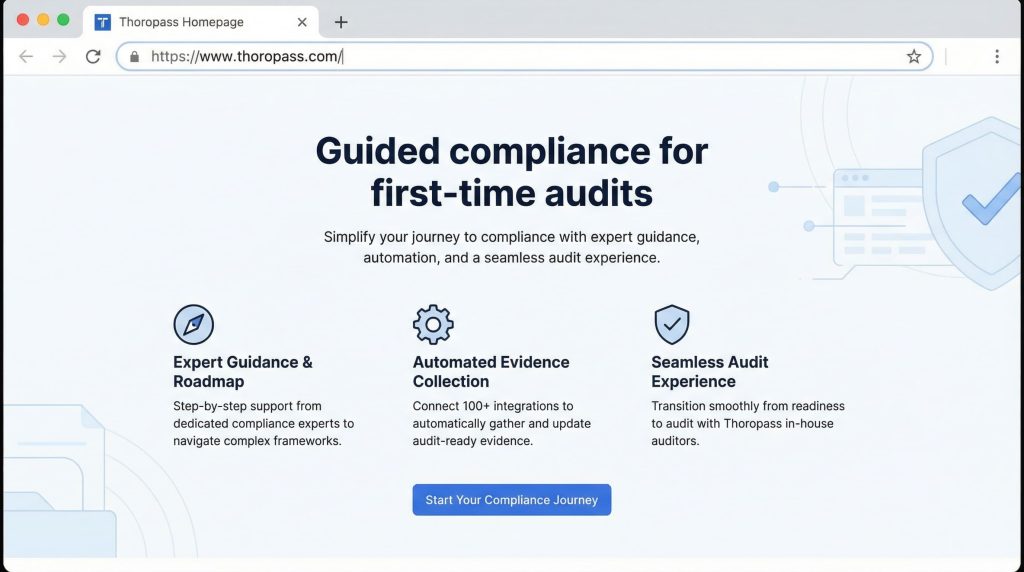
Thoropass: guided compliance for first-time audits
Thoropass is designed for teams that need to pass a first audit without building a compliance department overnight. It pairs an automation platform with in-house auditors, which is useful when you have a SOC 2 Type II deadline tied to the next sales quarter and you want someone to translate auditor feedback into a clear next step.
Thoropass is a strong fit if you are:
- A seed to SMB team running your first SOC 2 or ISO 27001 program
- Looking for “software plus guidance,” not just a control dashboard
- In a regulated path where HITRUST matters, and you want fewer handoffs between tools and audit workflows
What Thoropass does well
A guided audit model, not just a checklist
The platform collects evidence from cloud accounts, HRIS, and ticketing tools, while a named specialist helps you scope, resolve edge cases, and keep momentum. In practice, this feels like compliance office hours built into the product.
Framework breadth that grows with you
Thoropass supports 30+ frameworks and added eight new standards in June 2025, including DORA, WCAG 2, and NIST 800-53. If AI governance frameworks like ISO/IEC 42001 or NIST AI RMF are on your roadmap, it is worth confirming what is available today and how mappings are maintained as standards change.
Access reviews and integrations are expanding quickly
In February 2025, Thoropass added more than 50 new access-review integrations, including services such as Vercel and Microsoft Teams, and positioned total integrations as well above one hundred. For AI-native SaaS teams, access reviews are often where “audit readiness” becomes operational, especially as engineering tools multiply.
Audit collaboration and HITRUST workflows
Thoropass leans into an auditor-led delivery model. That can be a positive if you want tighter feedback loops and fewer interpretation gaps. The February 2025 release also included a MyCSF integration, which matters if you are pursuing HITRUST and want to reduce swivel-chair work between your compliance platform and the HITRUST portal.
Pricing and proof points
Pricing is quote-based. Thoropass promotes discounted startup bundles and claims customers save 25 to 50 percent compared with traditional audit firms. On user feedback, it holds a 4.7 / 5 rating from over 550 verified G2 reviews.
Watch-outs
If your biggest requirement is deep, engineering-first automation with explicit high-frequency test cadences across a complex CI/CD stack, validate that fit in a demo. Thoropass is often chosen for hands-on guidance and structured audit execution, not for “set it and forget it” automation alone.
Buyer checklist (questions to ask in a demo)
- What does “continuous” mean in practice for our stack? How often are key controls evaluated?
- Show the MyCSF workflow end-to-end if HITRUST is in scope. What evidence syncs automatically?
- Demonstrate access reviews for the tools we actually use (for example, GitHub, Vercel, Slack, cloud IAM).
- What is included in the quote—platform, audit services, or both? What changes as we add frameworks?
- If we need AI governance support, what ISO/IEC 42001 or NIST AI RMF content exists today?
Thoropass is a pragmatic pick when you want a faster, lower-stress first audit cycle and value having an auditor-aligned specialist embedded in the process.
Termly: Data privacy and consent management made easy
Termly is an all-in-one privacy compliance and consent management solution that enables small and medium-sized businesses to easily align with EU, U.S., and global privacy frameworks. Their consent management platform obtains, logs, and tracks user consent preferences automatically. It also features multiple legally backed policy generators, including a privacy policy generator tailored to meet the requirements of 30+ privacy laws, and a terms and conditions agreement that features an AI clause.
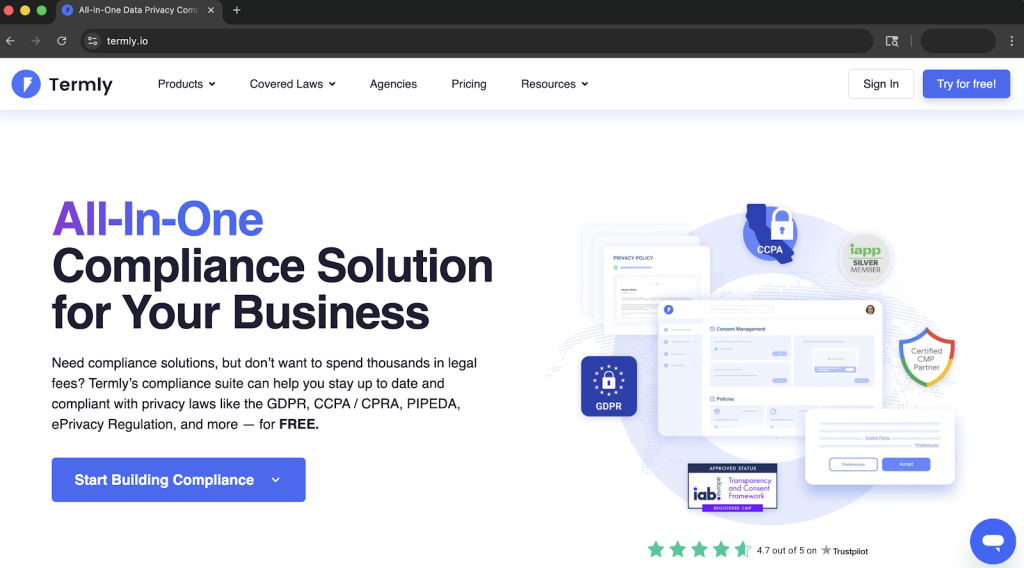
Termly solves multiple problems under a single umbrella by pairing robust cookie consent management with DSAR tools and legal policy generation. It’s a practical fit for data-rich apps and experimentation pipelines and even simplifies setups for compliant analytics and advertising by supporting Google Consent Mode and the IAB TCF v2.3.
Termly is a strong fit if you are:
- An AI company that relies on using personal data for any reason, including to train your AI, or for marketing and research purposes.
- Using analytics tools, cookies, or other trackers on your website or platform.
- Subject to complying with data privacy laws like the GDPR and CCPA.
- An organization serving EU users and needing EU-based storage alongside global privacy coverage.
Termly enables AI SaaS companies to transparently communicate with customers in a way that aligns with the current legal landscape. With a track record of keeping up with new and evolving laws, it also helps future-proof your efforts.
What Termly does well for AI-driven SaaS teams
Global data privacy coverage under a single interface
Termly centralizes alignment with all the major data privacy frameworks, including the GDPR and ePrivacy Directive, PIPEDA and Quebec’s Law 25, the CCPA/CPRA and other U.S. state laws, as well as broader regimes like POPIA. This way, you can scale your team into new markets without juggling multiple point tools.
Consent management that fits (and scales) with modern stacks
Termly gives you a customizable cookie banner, a preference center, an embeddable DSAR form, and a website scanner that detects, categorizes, and defines cookies, then automatically generates a tailored cookie policy for you. They also update the features regularly, which currently include multi-language support and regional consent settings. It also fully supports Google Consent Mode and the IAB TCF v2.3 and makes implementation smoother in contemporary frameworks.
EU-hosted data storage for trusted global privacy compliance
Termly offers EU data storage for European users, which is a practical requirement for many AI products. This helps reduce regulatory friction and strengthens trust with European customers. The company also has a detailed privacy center available with information about vendors, privacy settings, and security practices. This provides transparent insight into how data is safeguarded across confidentiality, integrity, and availability controls.
Pricing plans and partnerships
Termly offers a free plan with options to upgrade to the full platform and a pathway for agencies managing multiple client websites. The broader suit includes advanced consent management features, access to all policy generators, and expanded coverage across global privacy frameworks.
Watch-outs
With Termly, the feature depth varies by plan, as they make clear on their site. You can start by signing up for a free plan and expand into the full suite as your needs grow. Choose the plan that covers all regions and benefits you require.
Buyer checklist (questions to ask in demos)
- How does Termly stay up to date with changing global privacy laws?
- Walk me through how the platform runs automatic scans and categorizes cookies?
- How long does it take to fully set up Termly on a typical website?
- How does Termly perform for multi-site or multi-domain businesses?
- What kind of customer support is available on each plan?
Termly is ideal when you want to stay on the right side of privacy laws. It enables you to build privacy compliance into every aspect of your AI SaaS offerings and keeps your clients and their potential customers transparently informed.
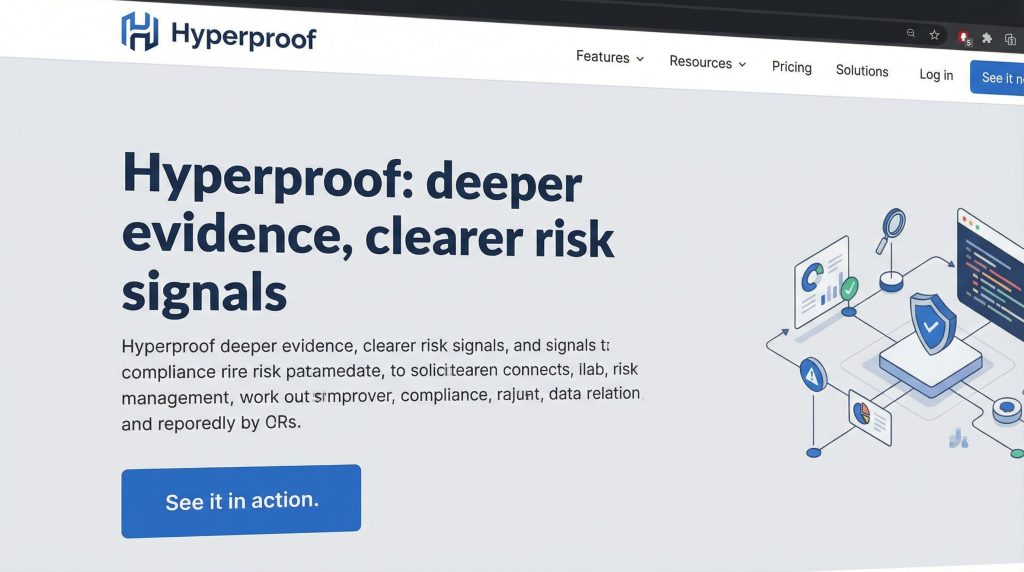
Hyperproof: deeper evidence, clearer risk signals
Hyperproof is built for security and compliance owners who treat control health as an operating metric, not an audit milestone. It pulls evidence from your systems, ties each artifact to the exact control it supports, and keeps dashboards current so drift shows up while it is still easy to fix.
Hyperproof is a strong fit if you are:
- A mid-market or enterprise security team that wants a live view of control health across multiple frameworks
- Running frequent internal reviews, leadership reporting, and recurring audits, and you want evidence to stay organized by design
- Looking for a structured audit workspace that reduces back-and-forth with auditors
What Hyperproof does well
Evidence mapping with near-real-time visibility
Hyperproof advertises more than 200 native integrations that pull evidence from cloud configuration, identity logs, ticket systems, and other common sources, making it easier to align compliance workflows with effective asset audit software across distributed systems.
Multi-framework coverage for teams that keep expanding scope
Hyperproof includes a library of 60+ frameworks, including SOC 2, ISO 27001, NIST CSF, PCI DSS, and DORA. The practical advantage is reuse: one control and one evidence trail can satisfy multiple standards without duplicating work.
Workflow loop from failed control to audit trail
When a control fails, Hyperproof can open a task, assign an owner, and timestamp actions as the issue is resolved. That keeps remediation and documentation connected, which auditors typically prefer over ad hoc screenshots and slide decks.
Audit collaboration, reporting, and risk programs
Hyperproof’s audit workspace is a key part of the product story. A published customer case study reports a 50 percent cut in audit-response effort after moving evidence exchange into Hyperproof’s audit workspace. For teams juggling multiple auditors, business units, or in-scope environments, centralizing that collaboration can remove a lot of operational drag.
Pricing and user feedback signals
Hyperproof typically lands in an upper-mid tier. G2 buyer data references annual contracts in the low six-figure range, with ROI in about 13 months. On satisfaction, Hyperproof is listed at 4.5/5 from nearly 200 verified G2 reviews.
Watch-outs
If your organization expects deep developer-native workflows, such as CI/CD gates, PR checks, or code-level remediation guidance, validate those specifics. Hyperproof is strong on evidence orchestration, tasking, and audit collaboration. The degree of “shift-left” CI/CD integration is something you should confirm against your exact engineering process.
Similarly, if AI governance frameworks are a near-term requirement, confirm whether ISO/IEC 42001 and NIST AI RMF templates and mappings are available today and how they are maintained.
Buyer checklist (questions to ask in a demo)
- Show evidence collection for our exact stack. What is automated, and how often does it refresh?
- Demonstrate cross-mapping from SOC 2 to ISO 27001 using a real control and real evidence.
- Walk through the audit workspace. How do auditors request evidence and how do we respond in-product?
- What VRM/TPRM capabilities are included versus add-ons? How deep are questionnaires and ongoing monitoring?
- If AI governance matters, what ISO/IEC 42001 or NIST AI RMF content exists now, and what is the update cadence?
If your goal is to turn compliance evidence into a reliable, always-current risk signal for leadership and auditors, Hyperproof is worth a serious look.
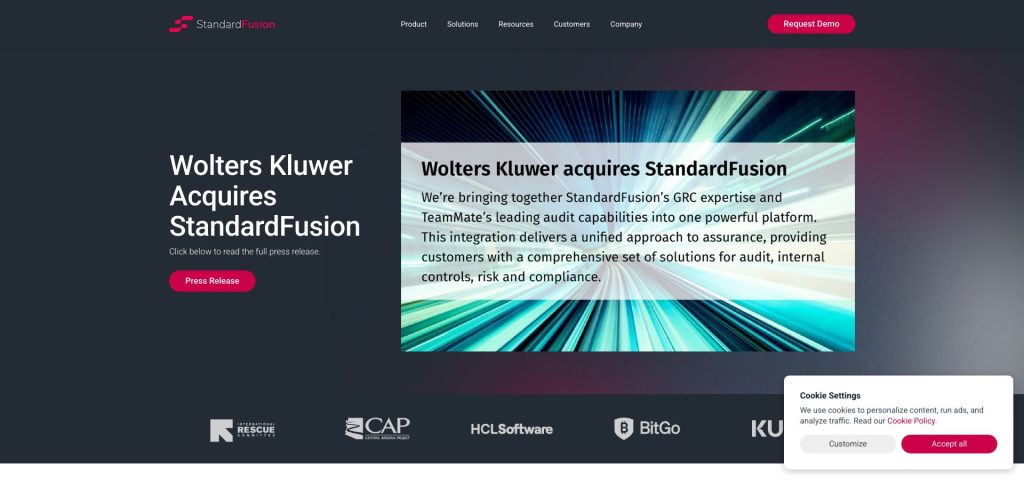
StandardFusion: unified risk-policy control for growing teams
StandardFusion is built for teams that need governance to stay consistent as the company scales. Instead of treating policies, risks, and controls as separate workstreams, it links them in one workspace, so a change to a policy clause can automatically roll through the controls and tasks it affects.
StandardFusion is a strong fit if you are:
- A growing security or GRC team consolidating policy management, risk tracking, and compliance execution into one system
- Managing multiple frameworks at once and trying to avoid duplicate controls and “FINAL_v6” documents
- Reporting regularly to leadership and need executive-friendly rollups, not just audit checklists
What StandardFusion does well
Policy, risk, and control linkage in one view
StandardFusion’s core strength is connection. Policies, risks, and controls live together, which helps reduce the common failure mode where a policy gets updated but the control narrative, tests, and evidence trail stay outdated.
Broad framework coverage, including AI governance signals
StandardFusion lists 150+ security and privacy frameworks, spanning SOC 2 and HIPAA through ISO 42001 for AI governance. For AI-native SaaS teams, that matters less as a checkbox and more as an indicator that AI governance can live alongside the rest of your program, not in a separate spreadsheet.
Executive-ready risk visibility
Dashboards roll up residual risk by business unit, then drill down to the vendor, policy, or control that is driving exposure. A customer case study reports a 75 percent reduction in board-deck preparation time after moving to the platform.
Automation and day-to-day operations
StandardFusion supports automated tasking for recurring work, including policy reviews and renewals, and notifications through collaboration tools like Slack or Teams. Where teams should be careful is assuming “continuous compliance” means the same thing across vendors. StandardFusion can be strong on governance workflows and control ownership. If you need high-frequency, automated technical testing across cloud, identity, and CI/CD, validate the depth and cadence during evaluation.
Pricing and user feedback signals
StandardFusion pricing is quote-based. A published note references plans that start below USD 100 per user, but you should confirm current packaging, minimums, and what is included for your scope. On G2, StandardFusion is listed at 4.4/5 from more than 180 verified reviews.
Watch-outs
StandardFusion typically takes longer to implement than plug-and-play startup tools. That time can pay off once multiple teams and frameworks are in play, but it is still a real cost. It is also worth validating VRM depth and auditor collaboration features if those are core requirements for your program.
Buyer checklist (questions to ask in a demo)
- Show how a policy change propagates. What updates automatically across linked controls, risks, and tasks?
- Demonstrate your automated evidence collection for our cloud and identity stack. What is pulled automatically versus uploaded?
- If AI governance matters, show the ISO 42001 content and how it maps into controls and reporting.
- What does “continuous” look like in StandardFusion for technical controls? What runs automatically, and how often?
- How do auditors and reviewers collaborate in the tool? Is there an auditor-facing workspace or a clean export workflow?
If your biggest pain is fragmented governance across policy, risk, and compliance workstreams, StandardFusion is a strong consolidation play. Just make sure the automation depth matches how fast your engineering team changes production.
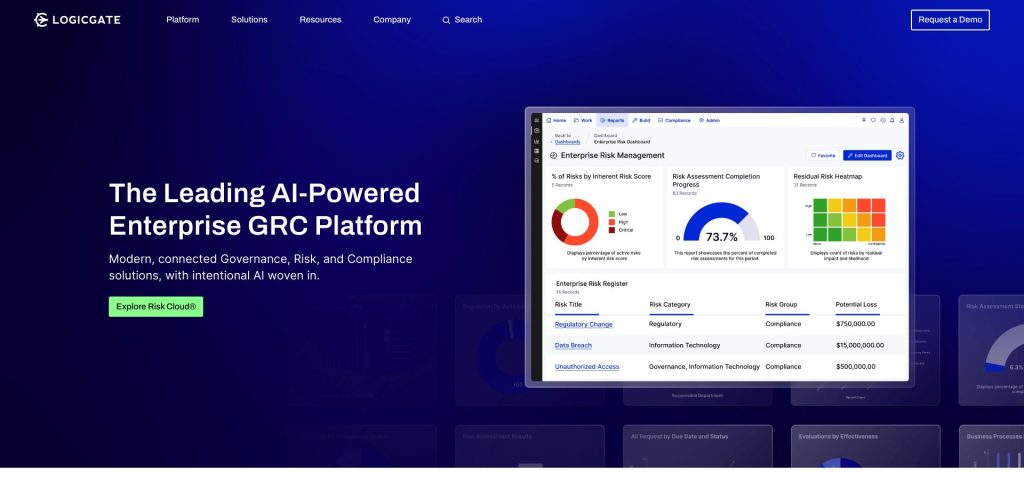
LogicGate Risk Cloud: build-your-own compliance workflows
LogicGate Risk Cloud is built for teams that need GRC to match the way the business actually runs. Instead of pushing you into a fixed compliance flow, it gives you a no-code, drag-and-drop builder so you can design workflows with the right approvals, handoffs, and escalation paths.
LogicGate Risk Cloud is a strong fit if you are:
- An enterprise team with multiple business units, complex ownership, or frequent process changes
- Standardizing GRC across risk, internal audit, compliance, and third-party workflows
- Willing to invest in configuration to get workflows that reflect real operational reality
What LogicGate does well
Workflow design is the product
If compliance at your company feels closer to product development than checklist hunting, LogicGate’s approach makes sense. Power users can link tickets, approvals, and sign-offs until the process matches your org, without submitting IT requests for every change.
Templates accelerate new use cases, including AI governance
LogicGate offers more than 150 pre-built application templates covering enterprise risk, third-party risk, and AI governance, which can shorten the time it takes to stand up a new program.
Measurable impact on handoffs
LogicGate reports that customers with complex org charts see a 50 percent drop in manual hand-offs after moving off spreadsheets, based on data from its Value Realization tool. For many large teams, that reduction in coordination overhead is the real ROI.
AI assistance and automation depth
Risk Cloud includes Spark AI, positioned to autofill evidence fields and speed up control mapping. The broader point is that LogicGate uses AI to accelerate work inside workflows, not to replace the need for a well-designed process.
If your top requirement is continuous technical control monitoring across cloud, identity, and CI/CD, validate how that will be achieved in your environment. LogicGate can be a great orchestration layer; the depth of out-of-the-box automated testing varies by how you configure the platform and how you connect data sources.
Pricing and licensing model signals
Pricing is modular. G2 buyer data points to typical contracts in the mid- to high-five-figure range per year. LogicGate also emphasizes that you license “power users,” and occasional reviewers do not add extra cost. That model can work well when many stakeholders need to participate but only a few people build and administer workflows.
Proof points and market feedback
On G2, LogicGate is listed at 4.6/5 from more than 180 verified reviews and has ranked a Leader for 22 straight quarters.
Watch-outs
LogicGate is typically not a “one afternoon and done” implementation. The flexibility is the point, but it also means you should plan for design, configuration, and ongoing administration. If you want the highest automation density out of the box, with minimal customization, compare it against automation-first platforms and weigh time-to-value.
Buyer checklist (questions to ask in a demo)
- Show how you would model one of our real workflows, for example, a control exception with legal review, security sign-off, and engineering remediation.
- What does Spark AI do today in our use case—control mapping, questionnaires, or evidence workflows?
- How will we connect the systems we care about, and what is automated versus manually routed?
- What is the implementation plan, who configures workflows, and what admin headcount should we expect long-term?
- What is included in our module scope, and how does power-user licensing work as we add business units?
LogicGate Risk Cloud is a strong choice when your biggest challenge is process complexity, not a lack of checklists. It gives you the building blocks to run GRC the way your organization actually operates.
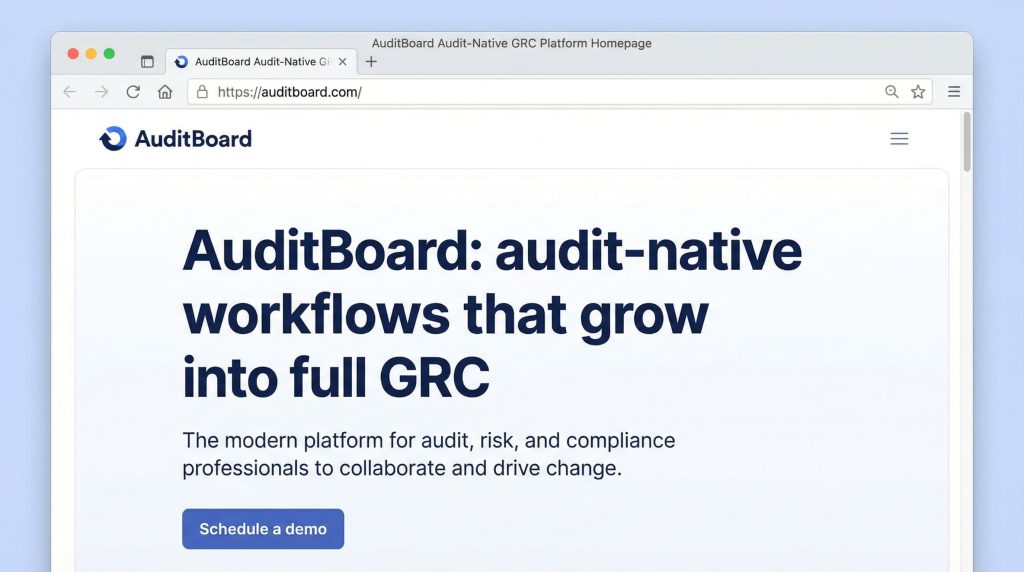
AuditBoard: audit-native workflows that grow into full GRC
AuditBoard is built for organizations where audit execution and traceability are non-negotiable. It started inside internal audit teams as SOXHUB, and that heritage shows in the workflows. Controls, evidence status, findings, and ownership are organized in a way auditors recognize immediately, which can reduce friction when your program is already mature.
AuditBoard is a strong fit if you are:
- Running SOX, preparing for an IPO, or managing IT general controls (ITGCs) across multiple systems
- A larger organization with multiple entities or business units and a need for consistent change control and audit trails
- Expanding beyond compliance into connected risk, ESG, and third-party risk management on a single platform
Where AuditBoard stands out
Audit-grade change management and traceability
AuditBoard is designed to keep narratives, tests, and linked controls in sync as programs evolve. Update a risk and AuditBoard can sync linked controls, tests, and narratives while preserving version history. That “single thread” is valuable when regulators and auditors expect you to prove not just that a control exists, but how it changed over time.
That change propagation can pay off operationally. Masonite International estimates it cut 75 percent of PMO time after moving to AuditBoard’s connected risk platform.
Enterprise scale and adoption signals
AuditBoard reports more than USD 300 million in ARR and service to half of the Fortune 500 as of October 2025. On user feedback, G2 lists a 4.6/5 rating from more than 1,500 verified reviews.
A modular suite that expands beyond audits
AuditBoard has grown into a broader GRC suite covering compliance, risk, ESG, and TPRM on the same data core. That matters when you want to add new programs without re-platforming or stitching together separate tools.
Automation, AI, and CI/CD fit (what to validate)
AuditBoard is strong on audit workflows, governance, and connected documentation. If your definition of “continuous compliance” depends on automated technical checks across cloud, identity, and infrastructure-as-code, validate what is native versus what is handled through workflows and evidence management. AuditBoard generally emphasizes audit operations over automation-first, high-frequency technical testing.
Similarly, AuditBoard’s AI capabilities are geared toward drafting, summarization, and mapping. If you want code-level remediation guidance or continuous evidence evaluation, ask for a live demo of those exact scenarios.
Implementation and pricing signals
AuditBoard states implementation averages 15 to 20 business days, while legacy suites can take four to six months. Pricing is modular; G2 buyer data suggests contracts commonly land in the high-five- to low-six-figure range per year. Treat that as directional until you scope modules and entities.
Watch-outs
If you are an early-stage team trying to get to your first SOC 2 quickly with minimal setup, an automation-first platform can be a faster on-ramp. AuditBoard tends to shine when you already need audit-native rigor, multi-entity governance, and connected programs across the organization.
Buyer checklist (questions to ask in a demo)
- Show how a risk change propagates to linked controls, tests, and narratives, and what the audit trail looks like.
- Demonstrate automated evidence collection for our specific stack (cloud, IdP, ticketing, developer tools). What is automated versus manually maintained?
- Walk through AuditBoard Assistant on a real task—does it summarize, map, and draft within our workflows?
- If TPRM matters, demo the end-to-end vendor workflow (intake, assessment, remediation, reporting) and clarify what is included in the module.
- If we want developer alignment, how do issues flow into engineering systems, and can we enforce controls in release processes?
If your roadmap includes SOX, IPO readiness, or multi-entity governance, AuditBoard is a serious contender because it delivers audit-grade structure today and can grow into broader GRC as your programs expand.
Scrut Automation: smart GRC for AI-native startups
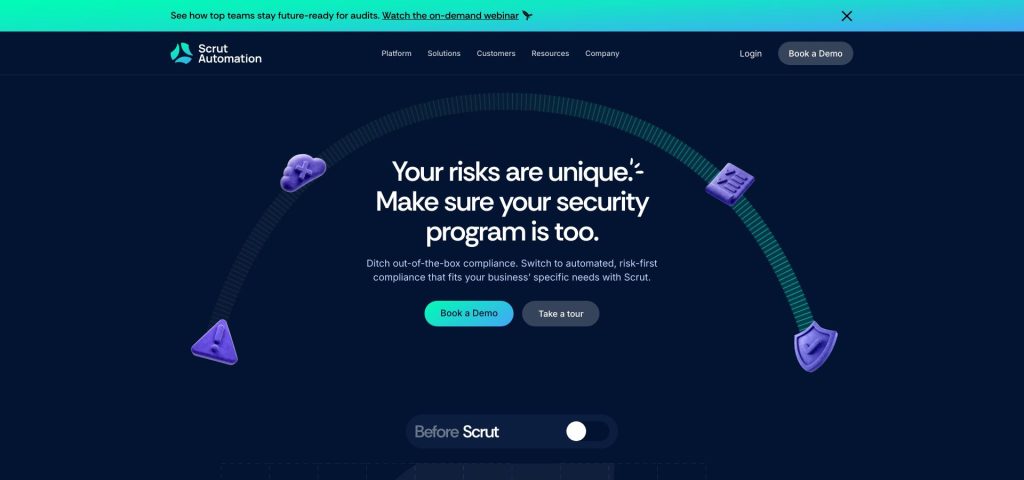
Scrut Automation is built for teams that treat compliance like a data problem, not a documentation project. Its “risk-first” posture is designed to help AI companies connect technical risks—like data leakage or insecure cloud configuration—to the controls auditors care about.
As a highly automated compliance management software, it seamlessly bridges the gap between fast-moving engineering environments and rigid audit frameworks.
Scrut is a strong fit if you are:
- A startup to lower-mid-market AI SaaS team optimizing for speed to SOC 2 and ISO 27001
- Looking for monitoring that turns misconfigurations into clear control status changes, not a quarterly audit scramble
- Building an early AI governance posture and want to evaluate ISO/IEC 42001 support alongside core security frameworks
What Scrut does well
Automation depth for common startup stacks
Scrut positions itself around full-stack visibility. It says it monitors more than 75 cloud services and developer tools, and that when a developer opens an unencrypted S3 bucket, the control status flips to “failing” in seconds, not weeks. Across Scrut materials, the integration count is often described in the 70+ to 75+ range, so it is worth confirming coverage for your exact stack during evaluation.
Framework versatility for fast-moving teams
Scrut markets support for 25+ frameworks, including SOC 2, ISO 27001, and ISO 42001 for AI management systems. If AI governance is a near-term requirement, also validate whether mappings exist for NIST AI RMF and how quickly templates evolve as standards change.
Strong customer sentiment on G2
Scrut reports a 4.8/5 average from more than 520 verified reviews on G2 and frequent “Leader” placement in Mid-Market GRC grids. As with any review signal, confirm recent feedback patterns during your buying cycle.
Implementation, audit readiness, and pricing signals
Scrut organizes packaging around “Growth” and “Enterprise” tiers. It also markets a “Cloud-Native” startup bundle that includes audit readiness for SOC 2 and ISO 27001 within 45 days, with pricing starting in the mid-four figures for early-stage teams.
Watch-outs
Scrut can be a strong option for getting through early audits quickly, but you should validate a few areas that commonly matter to AI-native SaaS teams:
- Monitoring cadence and depth: Internal market feedback often distinguishes “daily” monitoring from “hourly” leaders. Ask Scrut to show the exact test cadence and drift detection on your systems.
- Trust Center and questionnaire workflows: If you rely heavily on customer security reviews, run a POC that includes Trust Center sharing and multi-portal questionnaires. Some teams want more stability and depth here.
- Developer experience: If you need CI/CD-native guardrails, PR checks, or deep remediation guidance, confirm how issues flow into engineering and what guidance is generated when controls fail.
Buyer checklist (questions to ask in a demo)
- Show control status changing from a real cloud misconfiguration in our environment. How fast does it detect, and what evidence is captured?
- What is the monitoring cadence for our key controls, and is it consistent across integrations?
- Demonstrate SOC 2 and ISO 27001 readiness workflows end-to-end, including auditor collaboration and evidence export.
- Show Trust Center workflows and a real customer questionnaire automation example, especially if we handle multiple portals.
- If we care about AI governance, show ISO/IEC 42001 content today and explain how updates are handled as standards evolve.
Scrut is best evaluated as a fast-moving, risk-first compliance platform for AI startups. A short, hands-on POC will tell you quickly whether its automation depth matches how often your stack changes.
OneTrust: privacy muscle for data-hungry AI products
OneTrust is the heavyweight option when privacy and data governance are inseparable from your AI product. If your biggest exposure is personal data at scale, cross-border processing, consent, and DPIAs, OneTrust is designed to make those workflows operational, then layer compliance automation on top.
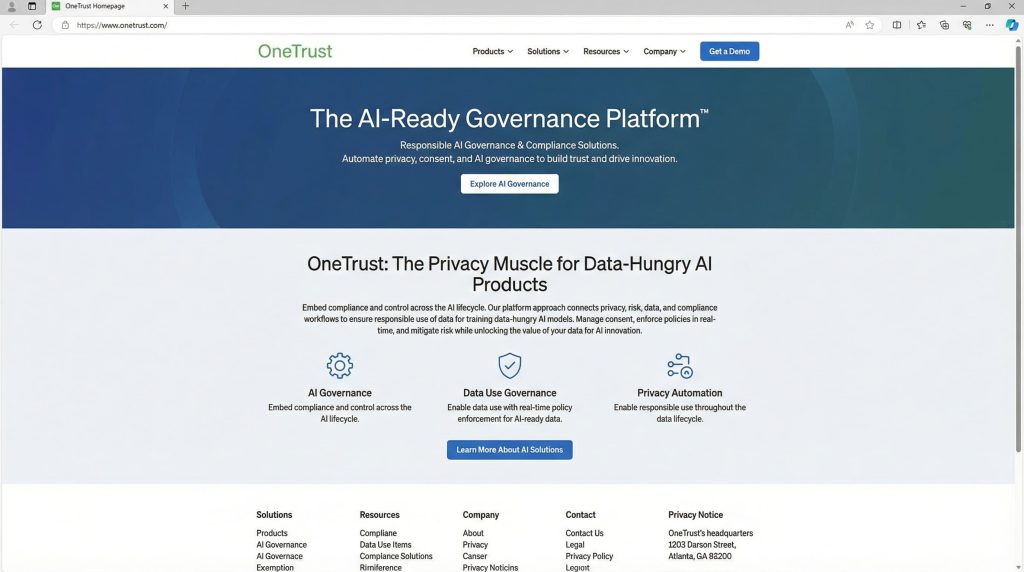
It is also widely adopted. OneTrust reports more than 14,000 customers, including 75 percent of the Fortune 100. That footprint matters if you sell to large enterprises that expect mature privacy operations, not just security attestations.
OneTrust is a strong fit if you are:
- Building AI products with a large privacy-asset inventory (systems, datasets, models touching personal data)
- Running GDPR and CCPA programs that require repeatable assessments, approvals, and documentation
- An enterprise team that wants privacy workflows and security compliance automation in one platform
What OneTrust does well for AI teams
Turns privacy requirements into fixable engineering work
OneTrust’s data mapping and “subway-style” data-flow views translate obligations into specific systems, vendors, and policies. That structure is helpful when product and engineering teams need clear answers to questions like “Where does this data go?” and “Who approved this use?”
Privacy assessments that keep pace with product changes
In AI products, the risk often changes when the data changes. OneTrust supports privacy impact assessments and related workflows, so when a new model use case increases sensitivity, the system can push the right review and approval path instead of relying on email threads.
Compliance automation for broader framework coverage
OneTrust introduced a Compliance Automation module that ships with 50+ out-of-the-box frameworks, from SOC 2 and ISO 27001 to DORA and HIPAA. The vendor claims this can cut compliance effort by up to 60 percent. For buyers, the key question is how much of that “effort reduction” comes from workflow automation versus automated technical control testing, and which controls are truly automated for your stack.
AI governance and third-party risk (what to validate)
OneTrust positions its AI governance features around the EU AI Act, ISO/IEC 42001, and NIST AI RMF. If those are on your roadmap, ask to see current templates and reporting outputs, and confirm how model inventory, lineage, and control evidence are handled in practice.
On third-party risk, OneTrust offers vendor-risk capabilities. If VRM is a primary driver, validate questionnaire depth, external signal ingestion, and how vendor findings connect back to your risk register and controls.
Pricing and user feedback signals
OneTrust pricing is usage-based. Its public FAQ describes metering tied to admin users and the size of your privacy-asset inventory. For AI products, that can be a feature—your cost scales with the governance surface area, not just seats.
On G2, OneTrust is listed at 4.4/5 across more than 270 verified reviews.
Watch-outs
If your top requirement is deep, continuous technical control monitoring across cloud, identity, and CI/CD, compare OneTrust carefully against automation-first compliance platforms. OneTrust is often strongest when privacy, data governance, and compliance orchestration are the center of gravity, and security frameworks are part of a broader trust program.
Buyer checklist (questions to ask in a demo)
- Show an end-to-end DPIA/PIA workflow triggered by a new AI model or new data source. What gets auto-populated, and what requires manual input?
- For Compliance Automation, which controls are backed by automated technical evidence in our environment versus process-based tasks?
- Demonstrate how frameworks like SOC 2 and ISO 27001 map into the same workspace as privacy programs.
- If AI governance is in scope, show current EU AI Act, ISO/IEC 42001, and NIST AI RMF support, plus how updates are maintained.
- Walk through pricing drivers with our expected privacy-asset inventory growth. What causes costs to increase over time?
When customer trust depends on more than a SOC 2 report, OneTrust is a strong option to operationalize privacy governance at scale and to connect that governance to broader compliance workflows.
Side-by-side snapshot
If you want the fast pass, use this grid to narrow your list to two or three tools. Then read the full profiles to confirm fit. All figures come from each vendor’s public product page or G2 profile (accessed January 2026). Pricing and packaging change often, so treat pricing notes as indicative and validate in a demo.
| Tool | Frameworks supported | Signature AI assist | Native integrations | Evidence collection | Vendor-risk module | Best fit |
| Vanta | 35+ | Remediation suggestions | 300+ | Real-time | Yes | Mid-market to enterprise (teams that want high automation) |
| Thoropass | 30+ | Control-gap analysis | 100+ | Continuous | Limited | First SOC 2 / ISO bid |
| Hyperproof | 60+ | Risk heat maps | 200+ | Trigger-based | Yes | Mid-market ops teams |
| StandardFusion | 150+ | Automated policy mapping | 75+ | Workflow-driven | Yes | Cross-team risk owners |
| LogicGate Risk Cloud | 150+ templates | AI-assisted questionnaires | 100+ | Tied to custom flows | Add-on | Enterprise workflows |
| AuditBoard | 35+ | Control auto-linking | 90+ | Audit-grade | Yes | SOX / IPO prep |
| Scrut Automation | 25+ | Automated risk mapping | 75+ | Real-time | Yes | AI-native SaaS |
| OneTrust | 50+ | Privacy-impact scoring | 100+ | Privacy and security | Yes | Data-heavy AI apps |
*Pricing summaries are indicative only. See vendor sites for current packaging and scope.
Numbers tell part of the story. Culture fit and roadmap alignment finish it. Use this grid to narrow your shortlist, then lean on the detailed sections for the nuance, trade-offs, and proof points.
Responsible AI in compliance
The EU AI Act took effect on 1 August 2024, and it makes most high-risk provisions enforceable from 2 August 2026. That shift changes the questions procurement and regulators will ask. Encryption and access controls still matter, but teams will increasingly need to explain why a model produced an output and how risk is monitored over time.
A new tool class is emerging to support that work. Platforms such as Credo AI inventory models, log lineage, score bias and robustness, and export reports aligned to the EU AI Act, NIST AI RMF, and ISO 42001. AdeptID’s data-science team says Credo AI helped them reach EU AI Act readiness ten times faster than manual tracking.
Why flag this in a GRC roundup? Because classic suites rarely detect model drift or track ML-specific risk in a way that stands up to an AI-focused questionnaire. Waiting until 2026 to operationalize model governance invites a last-minute scramble when a customer asks for “harm mitigation” evidence and you have nowhere reliable to pull it from.
Most SaaS teams will not replace their GRC stack. They will extend it:
- Control libraries gain AI-specific risks that map back to existing security and privacy programs.
- Model cards and governance artifacts drop into the same evidence workflows auditors already trust.
- Risk scores show up alongside SOC 2 and ISO metrics on executive dashboards, so leadership can see the full picture.
Conclusion
Regulations are accelerating, customer scrutiny is rising, and engineering speed keeps increasing. The platforms in this guide can help AI companies close the gap between how fast they build and how confidently they prove trust. Match the tool to your stage and stack, validate automation depth in a live demo, and start building a compliance posture that scales with every commit.
If you would like to receive the latest deals added to NachoNacho, make sure you sign up for our newsletter below. We’re adding amazing software discounts you can’t miss!
Sign up for our newsletter